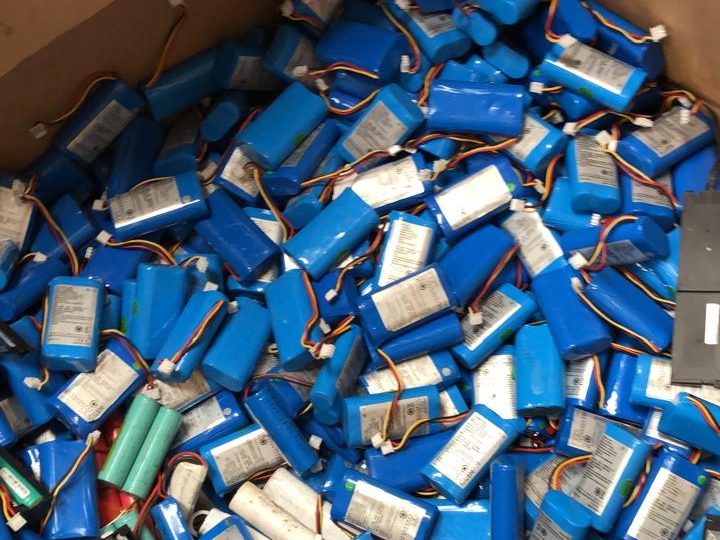
We repair lithium-ion batteries from e-bikes, scooters and electric motorcycles, power tools, hybrid and electric cars, buses, battery energy storage racks (BESS), forklifts and backup power systems (UPS). We test first, then fix the fault and measure the battery before returning it.
Updated September 26, 2026 · Reviewed by the Ecobaterías technical team
A reply within 48 business hours with the scope and the quote
Coordinated pickup with licensed transport across Chile
On this page
Ecobaterías repairs lithium-ion batteries in Chile: it replaces or reprograms the BMS (the electronics that measure and protect the cells), replaces weak cells and modules, rebalances the pack and replaces contactors, fuses, connectors and busbars. Every repair starts with a diagnostic and ends with a capacity test, and the battery comes back with a report of its state of health (SOH) before and after. A battery that is swollen, leaking, over-discharged or heat-damaged is not repaired: it goes to recycling.
What we repair
BMS and firmware · cells and modules · balancing · contactors, fuses and pre-charge · connectors and busbars
Chemistries
Lithium-ion only: LFP, NMC, NCA, LCO and LTO. We do not repair NiMH or lead-acid
Equipment
E-bikes, scooters and electric motorcycles · power tools · hybrid and electric cars · buses · BESS · forklifts · UPS
Customers
Companies and individuals, with coordinated pickup anywhere in Chile
Prerequisite
Diagnostic first: BMS, insulation, voltage per cell, internal resistance and capacity
Test time
30 min to 6 h per pack (lab time, not a delivery lead time)
Deliverable
Repair report with SOH before and after
Price and lead time
Confirmed in the quote, after the diagnostic
Which batteries do we repair?
We repair lithium-ion batteries for companies and individuals. Chemistry defines the work. We handle LFP (lithium iron phosphate), NMC (nickel manganese cobalt), NCA (nickel cobalt aluminum), LCO (lithium cobalt oxide) and LTO (lithium titanate).
We do not repair nickel-metal hydride (NiMH) batteries, used in several generations of the Toyota Prius, or lead-acid batteries. Their recycling is quoted separately.
Lithium-ion batteries we repair, by equipment
Equipment
Typical format
What we repair
E-bikes, scooters and electric motorcycles
36 V packs (10 cell groups in series), 48 V (13) or 52 V (14)
BMS, charging port, weak cell groups, balancing
Power tools
18 V packs: 5 cells of 3.6 V in series
Protection board, connections, cells
Hybrid and electric cars with lithium-ion batteries
Weak module, BMS, fuses, contactors, connectors and busbars
Forklifts and industrial traction
Traction packs, for example LFP
BMS, modules and connectors
UPS and telecom
Modules in cabinets
Modules, BMS and fuses
Swipe to see the whole table
Reference standards: EN 50604-1:2016 and UL 2271 for light electric vehicle batteries; ISO 12405-4:2018 for testing vehicle packs; IEC 62619:2022 for industrial lithium batteries, such as telecom, UPS, storage and forklift batteries. We use them as references for our method. They are not certifications we hold.
A pack failure usually sits in one part, not in every cell. According to Autocraft EV Solutions, across 559 commercial electric car pack repairs carried out in 2024, 92% of modules were still fit for automotive use and replacing 1.1 modules per pack on average was enough.
Lithium-ion battery faults: how they are detected, what we do and whether they can be fixed
Fault
How it is detected
What we do
Can it be fixed?
Weak cell or module: low capacity or high internal resistance
Capacity test, internal resistance and voltage spread between cells in the BMS
Replaced with an equivalent one in capacity and resistance, then rebalanced
Yes. It is the most common repair
Imbalance between cell groups
Voltage difference between groups, in the BMS or measured directly
Balancing: we equalize the charge of each group; if one cannot hold it, we replace it
Yes, if no cell is damaged
BMS or firmware
No communication, wrong state of charge or fault codes
Reset, reprogramming or board replacement
Yes
Contactors, fuses and pre-charge circuit
No output or no traction, fault codes, high contactor resistance
Component replacement
Yes
Loose or corroded connectors, cables and busbars
Thermography, voltage drop and inspection
Retightening or replacement
Yes
Coolant leak or water ingress
Inspection and insulation below the minimum
Drying, new seals and replacement of affected parts
It depends: not if the cells are corroded
Cells at 0 V or deeply over-discharged
Very low resting voltage
Not recovered for reuse
No
Swollen, deformed or leaking cell, melted areas, or a cell that heats up while off
Visual inspection and thermography
Packed as a damaged battery and sent to recycling
No
Thermal event or burn marks
Visual inspection
Packed as a damaged battery and sent to recycling
No
Swipe to see the whole table
Three terms from the table: a contactor is the switch that connects and cuts the pack’s high voltage; the pre-charge circuit limits current at the moment the pack is connected; busbars are the metal bars that join cells and modules.
We do not quote a repair without measuring the battery. The lithium battery diagnostic tells what failed, how much capacity is left and whether repair makes sense. Its main result is the state of health (SOH): how the battery performs today compared with when it was new, expressed as a percentage of its original capacity. More terms in the glossary.
What we measure before a repair and what each measurement reveals
Measurement
What it reveals
Reference
Visual inspection and thermography
Swelling, leaks, burn marks, hot spots and high-resistance connections
UL 1974:2023, rejection signs at intake
BMS readout
Fault codes, cycles, deep discharges, temperature events and cell spread
Regulation (EU) 2023/1542, art. 14 and Annex VII
High-voltage insulation
Current leaking to the chassis from water or damage
UN R100: at least 100 Ω per volt in DC; a 400 V pack needs at least 40 kΩ
Resting voltage per cell or group
Over-discharge and imbalance
First screen after visual inspection (Zhang et al., 2025)
DC internal resistance (DCIR) and at 1 kHz
Aged cells and loose connections
IEC 61960: a 0.2C pulse for 10 s, then 1C for 1 s
Capacity over a full charge and discharge cycle
Real energy and SOH
ISO 12405-4 (packs) and IEC 62660-1 (cells)
Swipe to see the whole table
The letter C expresses current relative to capacity: 1C discharges the full battery in one hour and 0.2C in five. A resistance test takes seconds; a capacity test takes hours. In our laboratory, testing a pack takes between 30 minutes and 6 hours.
Intake and quarantineRegistration with a unique code, visual inspection and thermography. Any battery that is swollen, dented, leaking or warm at rest is isolated and does not enter repair.
DiagnosticBMS readout, insulation, voltage per cell or group, internal resistance and a capacity test. The result is the fault found and the initial SOH.
Quote and decisionWe send you the fault, what we propose to replace, the price and the lead time. If repair does not make sense, we propose refurbishment, second life or recycling.
RepairWith the pack disconnected and using insulated tools, we replace the BMS or its firmware, the weak cells or modules with others matched in voltage, internal resistance and capacity, and any damaged contactors, fuses, pre-charge parts, connectors or busbars. We finish with balancing.
Exit testCapacity, internal resistance, insulation and a check of the BMS protections against overcharge, by voltage and by current, and against overtemperature, the controls IEC 62619 requires from the BMS of industrial batteries.
Handover and reportThe battery comes back with the repair report: fault found, parts replaced and SOH before and after. Removed cells or modules go to recycling with a certificate.
The sequence takes UL 1974:2023 as a reference: gather information, inspect, test and grade.
What do you receive after the repair?
Diagnostic report with the fault, the measurements and the route we recommend: repair, refurbish, second life or recycle.
Repair report with the parts, cells or modules replaced, the SOH before and after, and the exit internal resistance and insulation.
Intake and traceability certificate for the removed cells and modules we send to recycling, useful for your company’s reporting under Chile’s Extended Producer Responsibility law (Ley REP, Law No. 20,920).
Warranty per contract: its scope is set in writing in the quote. If you are a consumer, Chile’s consumer protection law (Law No. 19,496) also applies.
A note on transport: if the repair changes the type or number of cells, the BMS (hardware or software) or how the cells are connected, the battery may count as a new type under subsection 38.3 of the UN Manual of Tests and Criteria and need new tests to ship as dangerous goods. IATA’s 2026 guidance expressly mentions repair with non-original parts or parts of a different specification. When it applies, we say so in the report.
Location and condition: a damaged battery travels in special packaging
Swipe to see the whole table
International reference: in the United States, replacing the full battery of an electric car out of warranty costs between US$5,000 and US$16,000, and a replacement BMW i3 module about US$3,500, according to Recurrent. When the fault is in one or two modules, replacing only those modules avoids replacing the pack.
Some batteries are not opened for repair, because the risk is no longer about performance but about fire. The biggest one is thermal runaway: a chain reaction in which the cell heats itself until it releases gas, fire or both.
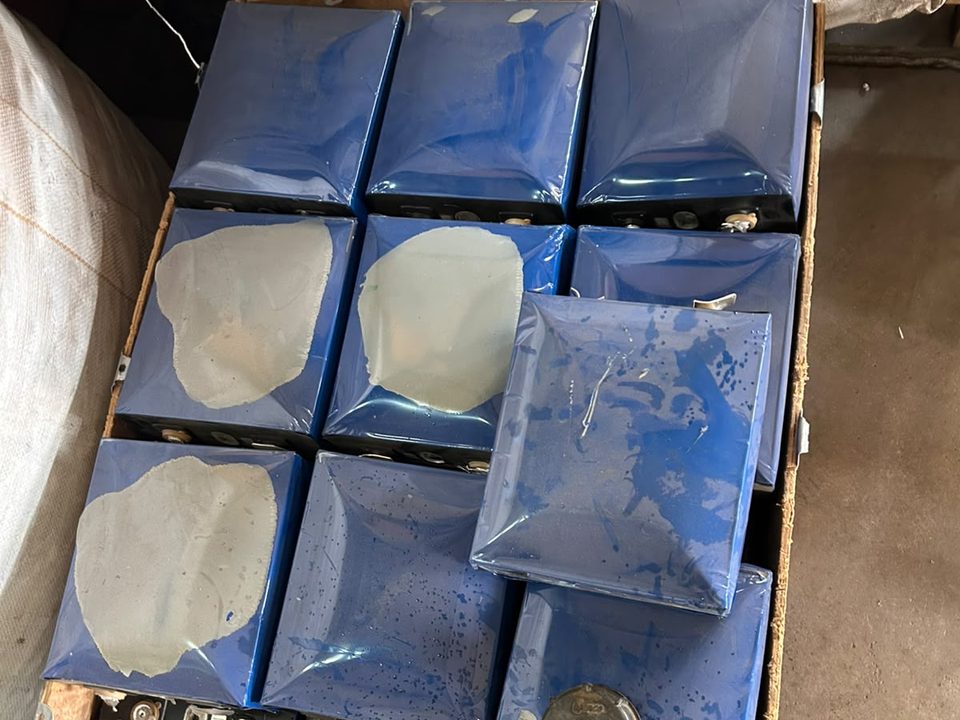
Prismatic cells with bulging cases. A swollen cell is not opened or repaired: it is packed as a damaged battery and sent to recycling.
We do not repair batteries in these conditions:
Swollen or deformed, leaking, smelling, with melted areas or heating up while switched off. ETH Zürich classifies them as damaged batteries.
With burn marks or a previous thermal event. UL 1974 rejects them at intake.
Over-discharged or at 0 V. According to Regulation (EU) 2023/1542, over-discharge reverses polarity and oxidizes the anode’s copper current collector, and even a minor over-discharge can grow dendrites and end in an internal short circuit. We do not recover them for reuse: they go to recycling.
With mechanical damage: dents, punctures or a crushed case or module.
A battery that is swollen, leaking, dented or heat-damaged ships as “damaged or defective” (UN special provision 376): in its own inner packaging, surrounded by non-combustible, non-conductive thermal insulation (packing instruction P908, packing group II), or in P911 packaging if it could react dangerously during transport. Damaged batteries that could produce dangerous heat, fire or a short circuit are forbidden on aircraft. We coordinate pickup with licensed hazardous-waste transport.
If a battery heats up, smokes or swells
Do not charge it or open it.
Move it at least 15 meters (50 feet) away from buildings and combustible materials. A damaged battery can reignite hours or days later: NTSB documented one case five days later.
If it burns or smokes, call the fire department (Bomberos, 132 in Chile) and cool it with plenty of water. An ABC extinguisher does not stop thermal runaway: NTSB recorded electric car fires that used more than 20,000 gallons (about 75,000 liters) of water.
If it is cold but swollen, wear gloves, tape the terminals and store it alone in a plastic container with sand or vermiculite, in a cool, dry place, away from metal and other batteries.
Repair means fixing a specific fault and returning the battery to the same use. Refurbishment means taking the pack apart, testing every cell and replacing the weak ones. When the problem affects the whole pack, another route pays off better:
Route we recommend based on the diagnostic result
Diagnostic result
Route we recommend
Fault in the BMS, a component or one or two modules, with no safety damage
Repair
Several weak cells or modules and SOH of 80% or more
Recycling with coordinated pickup and a certificate
NiMH or lead-acid battery
We do not repair it; its recycling is quoted separately
Repair costs almost as much as an equivalent new battery
We tell you in the quote
Swipe to see the whole table
Thresholds from the Ecobaterías test protocol: SOH ≥ 90% direct reuse · ≥ 80% refurbishment · 65–80% second life · < 65% recycling. These are in-house thresholds, not a standard.
In the European Union, a refurbished pack is called “remanufactured” only if all its cells were assessed, it recovers at least 90% of its original rated capacity and the SOH of its cells differs by no more than 3% (Regulation (EU) 2023/1542, art. 3(32)). UL 1974 treats “remanufactured”, “reconditioned” and “rebuilt” as equivalent.
Law No. 20,920. It defines preparation for reuse as checking, cleaning or repairing a discarded product so it can be used again without further processing (art. 3 No. 18). If the battery was already waste, repairing it is a form of valorization (art. 3 No. 30).
Draft battery decree (Res. Ex. 821/2026). It proposes targets for lithium-ion batteries of 5 kg or more: no target in the first two years, 15% in the third and 50% from the tenth, with at least 30% of the target met through preparation for reuse. It is a draft, not a rule in force: its public consultation closed on April 9, 2026, and the Ministry of the Environment’s deadline to propose the decree is January 29, 2027.
Regulation (EU) 2023/1542. It lists repairers among independent operators (art. 3(23)); since August 18, 2024, the BMS of light means of transport, electric vehicle and storage batteries must give read access to its state-of-health data (art. 14); and from February 18, 2027, the cells of e-bike and e-scooter batteries must be replaceable by an independent professional (art. 11). It does not apply in Chile; we cite it as a reference.
IEC 62619:2022. Safety of industrial lithium batteries; it requires the BMS to control overcharge and overtemperature. A reference standard, not a certification we hold.
UN 38.3 and transport. Eight UN tests for shipping lithium batteries: altitude, thermal, vibration, shock, external short circuit, impact, overcharge and forced discharge. An intact battery going to recycling travels under special provision 377 with P909 packaging; a damaged one under 376. What to require from an authorized waste manager.
Yes, when the fault is in the BMS, a fuse, contactor or connector, or a weak cell or module. It is not repaired if it has swollen, leaking, over-discharged or heat-damaged cells: that battery goes to recycling. According to Autocraft EV Solutions, across 559 electric car pack repairs carried out in 2024, 92% of modules were still fit. That is why we always start with a diagnostic.
Can a swollen lithium battery be repaired?
No. A cell that is swollen, leaking, has melted areas or heats up while switched off is considered damaged and is not opened for repair. Store it alone, away from combustible materials, and ship it as a damaged battery (UN special provision 376, P908 packaging). We coordinate pickup with licensed hazardous-waste transport and send it to recycling.
Why won’t my lithium battery charge?
The charger may have failed, a connector may be loose or a fuse blown, or the BMS may be cutting off charging because it detects overvoltage, overtemperature or an unbalanced cell group. If the cells were over-discharged or dropped to 0 V, we do not recover them: over-discharge damages the copper current collector and can cause an internal short circuit. The diagnostic separates these causes by measuring each cell group and reading the BMS.
Can the BMS of a lithium battery be repaired?
Yes. Depending on the fault, the BMS is reset or reprogrammed, or the board is replaced. Afterwards we check that it cuts off charging on overvoltage, excess current and overtemperature, the controls IEC 62619 requires from the BMS of industrial batteries. In the European Union, since August 2024 the BMS of light means of transport, electric vehicle and storage batteries must give read access to its state-of-health data (Regulation 2023/1542, art. 14).
Where can I get an e-bike battery repaired?
At Ecobaterías we repair lithium-ion packs from e-bikes, scooters and electric motorcycles: BMS, charging port, weak cell groups and balancing. A 36 V pack has 10 cell groups in series; a 48 V pack, 13; and a 52 V pack, 14. We take in batteries in Santiago and Viña del Mar and coordinate drop-off or pickup anywhere in Chile. Before quoting, we measure every cell group.
Can a cordless drill battery be repaired?
Yes, if the fault is in the protection board, a connection or some of the cells. An 18 V tool battery holds 5 lithium-ion cells in series. We replace weak cells with new cells matched in voltage and internal resistance, and test the capacity before returning it. If the case is deformed or a cell is swollen, it is not repaired and goes to recycling.
Can a hybrid battery be repaired?
Only if it is lithium-ion. Several generations of the Toyota Prius, for example, use nickel-metal hydride (NiMH) batteries, and we do not repair those. If your hybrid has a lithium-ion battery, the diagnostic shows whether replacing a module, a sensor or a contactor is enough. The chemistry is on the pack label or in the vehicle manual.
How long does a lithium battery last in an e-bike or electric motorcycle?
There is no single figure: it depends on the chemistry, the number of charge cycles, heat and how the battery is charged and stored. What can be measured is how much life is left. A capacity test gives the state of health (SOH) as a percentage of the original capacity, and that figure decides whether to repair, refurbish or recycle it.
How can I tell if a lithium battery is still good?
With measurements, not by eye. First, rule out visible damage: swelling, leaks, odor or heat while switched off. Then measure the resting voltage of each cell group, the internal resistance and the real capacity over a full charge and discharge cycle. Measured capacity against the original is the state of health (SOH): in our protocol, at 90% or more a battery is reused as is, and at 80% or more it can be refurbished for the same use.
How much does lithium battery repair cost?
It depends on the format, chemistry, fault and spare parts, so the price is confirmed in the quote, after the diagnostic. We reply within 48 business hours. For reference, in the United States replacing the full battery of an electric car out of warranty costs between US$5,000 and US$16,000, according to Recurrent; when the fault is in one or two modules, replacing only those modules avoids replacing the whole pack.
More answers on recycling, pickup and Chile’s EPR law in the FAQ.
Sources
Regulation (EU) 2023/1542 concerning batteries and waste batteries: art. 3 (definitions), art. 11, art. 14 and Annexes V and VII. Official Journal of the European Union, 2023-07-28. eur-lex.europa.eu
Closing the EV confidence gap: the role of battery remanufacturing (559 commercial repairs in 2024). Autocraft EV Solutions, 2025-05-06. autocraftsg.com
Damaged Lithium-ion Accumulator, safety sheet. ETH Zürich. ethz.ch
ANSI/CAN/UL 1974:2023, 2nd ed., Evaluation for Repurposing or Remanufacturing Batteries, and the UL Solutions overview (2024-05-21). webstore.ansi.org · overview (PDF)
IEC 62619:2022, Safety requirements for secondary lithium cells and batteries, for use in industrial applications. IEC. webstore.iec.ch
DCIR and ACIR: internal resistance under IEC 61960. Battery Design. batterydesign.net
Battery ecodesign preparatory study, Task 1, standards annex (VITO, Fraunhofer and Viegand Maagøe with the JRC), 2019: ISO 12405-4, IEC 62660-1, EN 50604-1 and UL 2271. eceee.org
Zhang, Guo, Ge, Mahon and Shen. Experimental Methods, Health Indicators, and Diagnostic Strategies for Retired Lithium-ion Batteries: A Comprehensive Review. arXiv, 2025. arxiv.org
48V vs 52V ebike battery (cell voltage and cells in series). EM3ev. em3ev.com
Costs of EV battery replacement. Recurrent, updated 2024-12-03. recurrentauto.com
UN Manual of Tests and Criteria, subsection 38.3 (PRBA copy). prba.org
RID 2025, special provisions 376 and 377 and packing instructions P908, P909 and P911, harmonized with the UN Model Regulations. OTIF. otif.org
Safety Risks to Emergency Responders from Lithium-Ion Battery Fires in Electric Vehicles, SR-20/01. NTSB, 2020. ntsb.gov
Damaged batteries. Cirba Solutions. cirbasolutions.com · Battery Collection Tip Sheet. US EPA, 2026. epa.gov
Law 20,920 establishing the framework for waste management and extended producer responsibility, art. 3. Biblioteca del Congreso Nacional de Chile. bcn.cl
Law 19,496 on the protection of consumer rights. Biblioteca del Congreso Nacional de Chile. bcn.cl
Res. Ex. 821/2026, draft battery targets decree, and Res. Ex. 4,225/2026, which extends the deadline to 2027-01-29. Ministry of the Environment of Chile. economiacircular.mma.gob.cl · mma.gob.cl
Toyota Prius (XW50). Wikipedia, secondary source. wikipedia.org
Ecobaterías test protocol: SOH thresholds and test times per pack. In-house thresholds, not a standard. ecobaterias.org
Updated September 26, 2026 · Reviewed by the Ecobaterías technical team
Get a quote for your battery repair
Tell us the equipment, the model, the chemistry if you know it, the fault and the location. We reply within 48 business hours with the diagnostic scope.
Reply within 48 business hours
Pickup coordinated with licensed transport across Chile
Technical report and certificate for every batch
Cobalt sulfate tested at Codelco El Teniente: 22% lower cost