Direct reuse
SOH ≥ 90%. Returns to an equivalent application with a state-of-health certificate.

Lithium battery service
Ecobaterías tests, repairs, refurbishes and reuses lithium batteries and solar panels, and manages the recycling of whatever can no longer be used, with pickup anywhere in Chile.
+56 9 4011 8111 · WhatsApp (opens in a new tab) · We reply within 48 business hours
Sources: Ecobaterías testing protocol (own threshold) · EU Regulation 2023/1542, art. 3(32) · Autocraft EV Solutions, May 6, 2025.
Updated September 26, 2026 · Reviewed by the Ecobaterías technical team
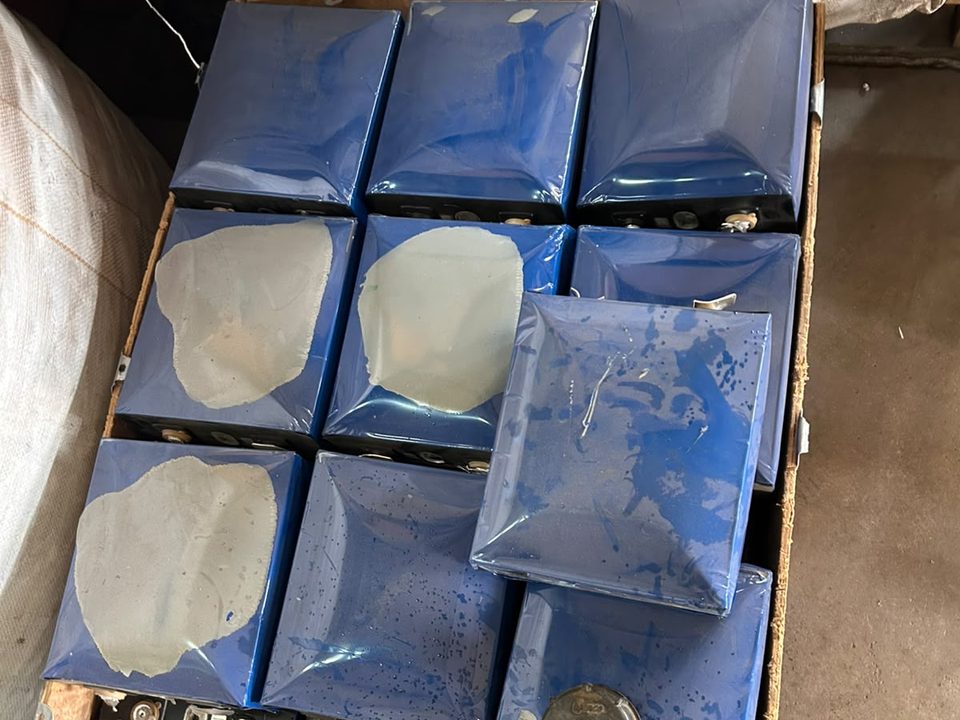
Lithium battery refurbishment means taking the pack apart, measuring every cell or module, replacing the weak ones, balancing and rebuilding it so it goes back to the same use, with a capacity test at the end. Ecobaterías refurbishes lithium-ion packs from electric buses and cars, battery energy storage (BESS) racks, forklifts and micromobility vehicles when their measured state of health is 80% or more; below that threshold, the pack goes to second life or recycling.
SOH threshold and test times: Ecobaterías testing protocol, published in lithium battery testing · September 18, 2026.
A lithium battery is made of cells, the basic electrochemical unit. Cells are grouped into modules, and the modules, together with the BMS (battery management system, the electronics that control voltage, current and temperature), the wiring and the casing, make up the pack. A pack rarely fails as a whole: a few cells or modules degrade and drag the rest down.
Refurbishing means opening the pack, measuring all its cells or modules, replacing the ones that fell behind, balancing and closing it again with a capacity test. The pack returns to the same application it had: a bus pack stays in a bus and a BESS (battery energy storage system) rack stays a rack. In Spanish, Ecobaterías calls this service pack refacción. If the modules move to a different use, such as stationary storage, it is no longer refurbishment: it is second life. A refurbished lithium battery leaves with its measured capacity written into the report.
State of health (SOH) compares the battery’s current performance with its initial state; in practice it is expressed as the capacity it still holds, as a percentage of the original. Our threshold for refurbishment is a measured SOH of 80% or more. “Remanufacturing” is something else: EU Regulation 2023/1542 only recognizes it when every cell and module is assessed, the battery recovers at least 90% of its original rated capacity and the state of health of its cells differs by no more than 3%, for the same purpose. UL 1974 treats “remanufactured”, “reconditioned” and “rebuilt” batteries as equivalent: all of them return to the same application.
Measuring module by module makes economic sense: according to Autocraft EV Solutions, in 559 electric-car battery repairs carried out in 2024, 92% of the modules in the faulty packs were still fit for automotive use and an average of 1.1 modules per pack had to be replaced.
| Service | End use | What is done | When it applies | What you receive |
|---|---|---|---|---|
| Repair | Same | A single fault is fixed: BMS, contactor, connector, fuse or one module | A localized fault in a pack that is otherwise healthy | Repair report with before-and-after testing |
| Refurbishment | Same | Full teardown, testing of every cell or module, replacement of the weak ones, balancing and a capacity test | Several degraded cells or modules, or a wide spread between them, with SOH of 80% or more | Rebuilt pack, output-capacity report and per-module record |
| Remanufacturing (EU criterion) | Same | Same as refurbishment, with two output measurements: ≥ 90% of original capacity and ≤ 3% SOH spread between cells | When the contract or the destination market requires the EU criterion | Report with both measurements |
| Second life | Different: stationary storage or backup | Grading and matching of modules for a new system | SOH of 65% to 80%, no damage | Matched block and usable-energy label |
| Recycling | Material recovery | Pickup, intake and management of the valorization | SOH below 65%, physical damage or thermal event | Valorization certificate |
Swipe to see the full table
Sources: EU Regulation 2023/1542, art. 3(28), (31) and (32) · UL Solutions, overview of ANSI/CAN/UL 1974:2023 (May 2024) · Autocraft EV Solutions, May 6, 2025 · SOH thresholds: Ecobaterías testing protocol.
The protocol follows the sequence of the standards for assessing used batteries (UL 1974 and IEC 63330-1): information and inspection first, then testing, grading and documentation. Every module stays identified from start to finish.
Testing takes from 30 minutes to 6 hours per pack, depending on its depth. The total refurbishment lead time depends on how many modules need replacing and is confirmed in the quote.
Sources: UL Solutions, overview of ANSI/CAN/UL 1974:2023 · IEC 63330-1:2024 · IEC 62619:2022 · UN Regulation No. 100 · test times: Ecobaterías testing protocol.
Which module stays and which one is replaced is decided with these measurements, not with the serial number or the vehicle’s model year.
| Test | What it measures | Method or reference |
|---|---|---|
| Open-circuit voltage (OCV) | Approximate state of charge, over-discharged cells and imbalance | Measured at rest; first filter after visual inspection |
| Capacity | Real available energy; SOH is calculated from it | Full charge and discharge cycle. IEC 62660-1 (battery-electric vehicle cells): 1/3 It at 25 °C; IEC 62620 (industrial batteries): 1/5 It at 25 °C; ISO 12405-4 for packs |
| DC internal resistance (DCIR) | Losses and ability to deliver power | IEC 61960: a 0.2C pulse for 10 s followed by a 1C pulse for 1 s |
| AC resistance at 1 kHz (ACIR) | Ohmic resistance; quick comparison between modules | IEC 61960; usually about 70% of DCIR |
| Self-discharge | Micro short circuits and unwanted internal reactions | Voltage drop at rest (our protocol: 24 h); IEC 62620 uses 28 days at 25 °C |
| Insulation | Leakage between the high-voltage circuit and the casing | UN Regulation No. 100: minimum of 100 Ω/V on DC and 500 Ω/V on AC |
| BMS readout | Cycle count, peak temperatures, deep discharges and logged faults | In the EU, electric-vehicle, light-means-of-transport and stationary storage batteries must provide read access since August 18, 2024 (Regulation 2023/1542, art. 14) |
Swipe to see the full table
Two definitions to read the table: It is the reference current of a test, equal to rated capacity divided by one hour; C is the current that fully discharges the battery in one hour, so 0.2C discharges it in five hours.
Sources: European Commission battery ecodesign preparatory study, standards annex (2019) · Battery Design, DCIR and ACIR · Zhang et al., review of diagnostic methods for retired batteries, arXiv, 2025 · UN Regulation No. 100 · EU Regulation 2023/1542, art. 14.
In a pack, cells and modules connected in series carry the same current. The BMS stops charging when the fullest cell reaches its maximum voltage and stops discharging when the emptiest one reaches its minimum. That is why a pack delivers the energy of its weakest module, not the average.
Matching means keeping only modules with similar capacity and internal resistance in the pack. Balancing means bringing them to the same state of charge before closing it. Without both, the pack is again limited by its weakest module. UL 1974 requires the operator to have a grading system and recommends a band of 6 sigma (six standard deviations) or tighter.
Source: UL Solutions, overview of ANSI/CAN/UL 1974:2023. Matching by capacity and internal resistance is part of the Ecobaterías protocol.
Whatever the end-of-line test measures. We do not promise a percentage before testing: we write it into the report after measuring. Three references help read that number:
Sources: EU Regulation 2023/1542, art. 3(32) · Zhang et al., arXiv, 2025 · Recurrent, November 11, 2025 · 80% threshold: Ecobaterías testing protocol.
| Criterion | We refurbish | We do not refurbish (and what we do instead) |
|---|---|---|
| Chemistry | Lithium-ion: LFP (lithium iron phosphate), NMC (nickel manganese cobalt), NCA (nickel cobalt aluminum), LCO (lithium cobalt oxide) and LTO (lithium titanate) | NiMH, used in many Toyota hybrids, lead-acid and other chemistries: quoted separately for handling as waste |
| Measured state of health | 80% or more | 65% to 80%: second life. Below 65%: recycling |
| Physical condition | No mechanical damage, swelling, leaks or thermal event | Swollen, leaking, dented or with burn marks: recycling as a damaged battery |
| Voltage | Within the manufacturer’s operating range | Over-discharged or at 0 V: not recovered for reuse; it goes to recycling |
| Information | Identifiable model and, preferably, readable BMS data | No possible identification: assessed case by case after testing |
Swipe to see the full table
IEC 63330-1:2024, which we use as a reference for assessing used batteries, is also limited to lithium-ion with data traceability and leaves out NiMH and lead-acid. If you do not know your battery’s chemistry, testing confirms it before we quote.
Source: IEC 63330-1:2024, scope · acceptance criteria: Ecobaterías testing protocol.
Sources: Reporte Minero, February 2026 · Recurrent, November 11, 2025 · Recurrent, battery replacement costs (December 2024) · National Energy Commission, via Reporte Minero, May 2026 · IEC 62619:2022 · EU Regulation 2023/1542, art. 11.
If a pack is hot, smoking or swollen, do not open or handle it. Move away and isolate the area: the US National Transportation Safety Board (NTSB) recommends keeping a vehicle with a damaged battery at least 15 m (50 ft) from structures and combustible materials. Cool it with plenty of water and call the fire department (132 in Chile). An ABC extinguisher does not stop thermal runaway (uncontrolled self-heating of a cell), and a damaged battery can reignite hours or days later: the NTSB documented one case five days later.
Sources: ETH Zürich, damaged lithium-ion battery fact sheet · UL Solutions, overview of UL 1974:2023 · EU Regulation 2023/1542, Annex V, point 4 · NTSB, Safety Report SR-20/01 (2020).
| Standard | Title | What we use it for |
|---|---|---|
| ANSI/CAN/UL 1974:2023 (2nd ed.) | Evaluation for Repurposing or Remanufacturing Batteries | Assessment sequence (information, inspection, testing, grading), grounds for rejection and label content |
| IEC 63330-1:2024 | Repurposing of secondary batteries – Part 1: General requirements | What to review when assessing a used battery: critical fault history, residual performance and repair history |
| IEC 62619:2022 | Safety requirements for secondary lithium cells and batteries, for use in industrial applications | BMS functions we check in the end-of-line test |
| UN 38.3 | UN Manual of Tests and Criteria, sub-section 38.3 | Eight tests the battery type must have passed to be shipped as a product |
| EU Regulation 2023/1542 | EU Batteries Regulation | Definition of remanufacturing (art. 3(32)) and of state of health (art. 3(28)) |
Swipe to see the full table
We cite them as method references. They are not Ecobaterías certifications and we do not present them as such: what we deliver is the report with measured data, so that the client, its engineer or an auditor can verify it.
If the refurbished pack goes into a storage system installed in Chile, note that Technical Instruction RGR No. 06/2024 from the Superintendencia de Electricidad y Combustibles (SEC, Chile’s electricity and fuels regulator) requires lithium-ion batteries and their BMS to comply with IEC 62619 (the instruction cites the 2017 edition), UL 1973 or UL 9540, and does not mention used or refurbished batteries. The installation is declared by the licensed electrical installer; we recommend checking with the SEC before reinstalling.
Sources: ANSI/CAN/UL 1974:2023 · IEC 63330-1:2024 · IEC 62619:2022 · United Nations, sub-section 38.3 (PRBA copy) · SEC, Technical Instruction RGR No. 06/2024.
We coordinate pickup with licensed hazardous-waste transport anywhere in Chile; packaging and documents are covered in collection and transport of batteries and panels. Do not take the pack apart before pickup: the Ministry of the Environment’s draft battery decree asks for lithium batteries to be handled and transported without dismantling them or stacking them excessively, so they do not lose their second-life potential.
On the way back, the refurbished pack travels as a product: lithium-ion, UN 3480, class 9 (miscellaneous dangerous goods). For that, its type must have passed the eight UN 38.3 tests: altitude simulation, thermal test, vibration, shock, external short circuit, impact or crush, overcharge and forced discharge.
Sources: United Nations, sub-section 38.3 and 38.3.2.2 · IATA, lithium battery guidance 2026 · OTIF, RID 2025 (harmonized with the UN Model Regulations) · Ministry of the Environment, draft battery decree (Res. Ex. 821/2026).
We do not publish a fixed term. The warranty is agreed in each contract, based on the capacity measured in the end-of-line test and on how the pack will be used.
If the buyer of a refurbished battery is a consumer, Chile’s consumer protection law (Law No. 19,496) also applies: the product must be disclosed in writing, before the sale, as refurbished or containing used parts (art. 14), and the legal warranty is 6 months (art. 21, as amended by Law No. 21,398). Between companies, the contract governs.
Sources: Law No. 19,496, Library of the National Congress of Chile · Law No. 21,398, Library of the National Congress of Chile.
Batteries are a priority product under Chile’s Extended Producer Responsibility law (Ley REP, Law No. 20,920). If the pack has already been discarded, refurbishing it fits “preparation for reuse”: checking, cleaning or repairing a discarded product so it can be used again without any other processing. The law includes it within valorization, alongside recycling.
The draft battery decree (Res. Ex. 821/2026) proposes that at least 30% of the lithium-ion target be met through preparation for reuse. It is a text under consultation, not a rule in force: the Ministry of the Environment’s deadline to propose the decree is January 29, 2027. More context in Chile’s EPR law and batteries.
Sources: Law No. 20,920, art. 3 No. 18 and 30 and art. 10, Library of the National Congress of Chile · Ministry of the Environment, Res. Ex. 821/2026 · Ministry of the Environment, deadline extension (Res. Ex. 4,225/2026).
Refurbishment sits in route B of the four-route scheme we use across all our battery services, so that the same pack always gets the same decision:
SOH ≥ 90%. Returns to an equivalent application with a state-of-health certificate.
SOH ≥ 80% and no safety faults. A single fault is repaired; if several modules are weak, the pack is refurbished: they are replaced, the pack is balanced and it returns to its original use.
SOH 65–80%. Modules are graded and integrated into stationary storage.
SOH < 65% or a safety fault. Pickup and intake for recycling with a valorization certificate.
State-of-health thresholds: Ecobaterías testing protocol · September 18, 2026. All routes in services for lithium batteries and solar panels.
It is quoted per pack or per batch, after testing. The price depends on:
Modules removed from the pack are received for recycling at 22 UF per tonne plus VAT (19%), with traceability and a valorization certificate for EPR reporting. The UF is Chile’s inflation-indexed accounting unit, published daily by the Central Bank (see the intake price). Lead times are confirmed in the quote.
If the pack has a single fault and the rest is healthy, a repair is probably enough. General questions are answered in the FAQ and technical terms in the glossary.
datos/estadisticas.json.Tell us model, chemistry, quantity and location. We test the pack and tell you whether it should be refurbished, repaired, given a second life or recycled.
For a single fault: BMS, cells, contactors or connectors, with before-and-after testing.
Modules at 65–80% state of health, matched for stationary storage.
The test that sets the route for each pack before we quote.