Lithium battery recycling for companies
Price per tonne, SIDREP reporting and a certificate for Chile’s EPR law.
Read
Battery and panel logistics
Ecobaterías tests, repairs, refurbishes and reuses lithium batteries and solar panels, and manages the recycling of whatever can no longer be used, with pickup anywhere in Chile.
Updated September 26, 2026 · Reviewed by the Ecobaterías technical team
Sources: RID 2025 (OTIF), Table A · DS 148/2003, Arts. 31 and 83 · 2026-09-26
We collect lithium-ion batteries and photovoltaic modules anywhere in Chile, from a box of power-tool batteries to BESS (battery energy storage) modules or pallets of panels from a solar plant: we coordinate pickup with licensed hazardous-waste transport. We tell you how to pack each batch by risk and which documents your company issues, including the SIDREP form (Chile’s national hazardous-waste declaration and tracking system), and at closing we issue an intake, traceability and valorization certificate for Chile’s Extended Producer Responsibility law (Ley REP, Law No. 20,920). We reply within 48 business hours.
In Chile, hazardous waste (RESPEL) is waste with at least one hazardous characteristic: toxicity, flammability, reactivity or corrosivity (Supreme Decree (DS) 148, Art. 11). End-of-life lithium batteries are handled as hazardous waste unless a characterization shows otherwise. According to Chile’s Ministry of Energy, so are end-of-life or damaged solar panels, unless they are declassified under DS 148. That is why a pickup follows hazardous-waste rules.
| Material | Collected? | Condition |
|---|---|---|
| Lithium-ion batteries (LFP, NMC, NCA, LCO, LTO) from phones, laptops, power tools, e-bikes, scooters, forklifts, electric cars and buses | Yes | Intact or damaged; damaged units are declared and packed separately |
| Battery energy storage (BESS) modules and racks | Yes | Dismantled; a complete container is assessed case by case |
| Crystalline silicon PV modules (mono, poly, bifacial) | Yes | Whole or with broken glass, on pallets |
| Thin-film modules (CdTe, CIGS) | Quoted case by case | CdTe contains cadmium and tellurium, both List II constituents under DS 148 |
| Complete electric vehicle with the battery installed | Assessed case by case | Ships as a vehicle (UN 3556), not as a battery |
| Lithium-metal, NiMH (nickel-metal hydride), lead-acid and other chemistries | Quoted separately | State the chemistry in your request |
| Household alkaline batteries | No | They go to battery drop-off points |
Swipe to see the whole table
Sources: DS 148/2003, Arts. 11 and 18 · Ministry of Energy, Circular Economy Roadmap for Energy 2026–2030 · RID 2025, special provision 388 · 2026-09-26
What happens to each chemistry after pickup is covered in lithium battery recycling for companies and solar panel recycling. Price and cost drivers are further down, under what a pickup costs.
A pickup takes seven steps. You provide the batch details and the generator’s documents; we tell you how to pack, coordinate the transport and the licensed destination, and issue the certificates.
| Detail | Example | What we use it for |
|---|---|---|
| Type and format | 20 scooter packs; 6 BESS modules; 300 panels rated 550 W | Sets the classification and packaging |
| Chemistry or technology | LFP, NMC or LTO; mono or poly silicon; CdTe | Sets the UN number and the recycling route |
| Weight or units | Total kilograms or per unit; number of pallets and their weight | Sets the vehicle and the cost |
| Condition | Intact, swollen, leaking, dented or burned; panel whole or with broken glass | Damaged units ship under a different special provision (SP 376) |
| Location | Region, municipality and address, or site coordinates | Sets the route and lead time |
| Access and loading | Forklift, loading crew, hours, dock height, site entry requirements | Sets the equipment that must go |
| Documents | Whether your site is already registered in SIDREP; whether you need a certificate for Law No. 20,920 or DS 22/2025 | Sets how the pickup is closed |
Swipe to see the whole table
Attach photos of the batch, of the battery label or of the panel nameplate. If you don’t know the chemistry, say so: we identify it from the label photos or during lithium battery testing. You can send the request through the pickup form or on WhatsApp (opens in a new tab).
Lithium batteries are dangerous goods and are packed under the UN Recommendations (Model Regulations), which Chile’s DS 298 refers to. Three concepts drive packaging: the UN number, a four-digit code that identifies the goods; the special provision (SP), a rule that adjusts the requirements for a case, such as batteries shipped for recycling or damaged batteries; and the packing instruction (P or LP), which sets the packaging. The packing group states how demanding the packaging is: group I is more demanding than group II.
| Case | Classification | Rule and packaging | What to do on site |
|---|---|---|---|
| Small intact batteries (phones, laptops, power tools, e-bikes) in a drum or box | UN 3480; UN 3481 if contained in equipment | SP 377 + P909: drum, box or jerrican meeting packing group II; a metal drum needs a non-conductive liner. If they are cells of 20 Wh or less or batteries of 100 Wh or less, a strong box of up to 30 kg gross is enough | Tape the terminals or bag each battery, and fill voids with non-conductive, non-combustible material so nothing moves |
| Intact packs from cars, buses and machinery | UN 3480 | SP 377 + P909: a pack of 12 kg or more with a strong casing needs only a strong outer packaging, crate or pallet, without a UN-tested package; it may exceed 400 kg net | Do not dismantle the pack; protect the terminals against short circuit and secure it so it cannot move |
| Dismantled, intact BESS modules | UN 3480 | SP 377 + P909, same as packs | Cover each module’s terminals and do not overstack |
| Complete, intact BESS container | UN 3536 | SP 389: batteries of a type tested under UN 38.3, secured in racks or cabinets, with protection against overcharge and over-discharge; class 9 placards on two opposite sides of the container | Gather the manufacturer’s documentation; if the container does not meet these conditions, shipping it as modules is assessed |
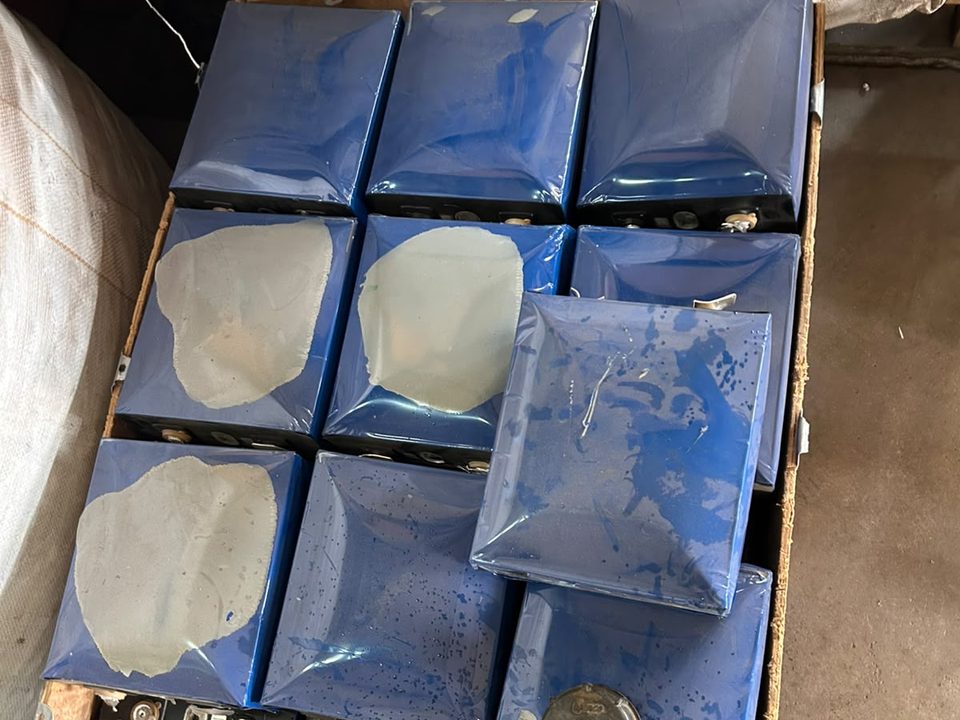
| Damaged, swollen, leaking or dented batteries, or batteries that cannot be diagnosed | UN 3480 | SP 376 + P908 (LP904 for a single large battery): each in its own inner packaging, with non-combustible, non-conductive thermal insulation, absorbent if leaking, and only one per outer packaging above 30 kg. If it is hot, smoking or liable to react: P911 or LP906, packing group I | Separate it from healthy batteries and describe it in your request; it cannot travel by air |
| Whole PV modules | No UN number: not dangerous goods | On pallets, with nothing on top. If they go to testing or reuse and are not waste, they travel as general freight; if they are waste, with licensed transport and SIDREP | Lift them with two people, by the short side and never by the junction box; keep them apart from broken ones |
| PV modules with broken glass | No UN number; hazardous waste unless declassified | Separate, labeled pallet; licensed hazardous-waste transport and SIDREP | They cannot be repaired and go to recycling. Do not handle them without protection or touch exposed cables (electric shock risk) |
Swipe to see the whole table
Sources: RID 2025, special provisions 376, 377 and 389 and packing instructions P908, P909, P911, LP904 and LP906 · JinkoSolar, storage instruction · JinkoSolar, installation manual V11 · QUASAR D2.2 · 2026-09-26
UN 38.3 is the UN test series that every new lithium battery type must pass; the manufacturer makes a summary of those tests available. Batteries shipped for recycling (SP 377) do not need it. Your quote states the packing instruction that applies to your batch. By air, loose lithium-ion batteries must travel at a state of charge of 30% or less, damaged batteries are forbidden and waste batteries need state approval, which is why these batches do not ship by air.
Source: IATA, Lithium Battery Guidance Document 2026 · 2026-09-26
A solar panel produces voltage under any light and only stops when covered with an opaque material. For weight planning, a current 2.28 × 1.13 m module weighs about 32 kg and a factory pallet holds 36 modules: roughly 1.15 t per pallet before packaging.
Sources: JinkoSolar, Tiger Neo 570–590 W datasheet · JinkoSolar, installation manual V11 · the per-pallet weight is our own calculation · 2026-09-26
To keep the option of using them again, avoid throwing, overstacking or dismantling batteries and panels during collection and transport. The final proposal of DS 22/2025 asks this for panels, and the draft battery decree asks it for batteries. A whole pack can have a second life and a whole panel can be reused.
Sources: Ministry of the Environment, final proposal of the batteries and electrical equipment decree (Exempt Resolution 3413/2025) · Ministry of the Environment, draft battery decree (Exempt Resolution 821/2026) · 2026-09-26
Class 9 is the UN dangerous-goods class that lithium batteries belong to. A battery shipment carries these labels, marks and statements:
The carrier placards the vehicle: class 9 placards visible from the front, rear and sides (DS 298, Art. 4) and a sign with the name of the load, the consignee, the consignor and the carrier, with their phone numbers (Art. 20 bis). Solar panels carry no UN label; if they are hazardous waste, the pallet is labeled under DS 148.
Sources: RID 2025, 5.2.2.2 and special provisions 376 and 377 · DS 298/1994, Arts. 4 and 20 bis · DS 148/2003, Arts. 4 and 8 · 2026-09-26
A hazardous-waste pickup complies with two regulations at once, and each one requires its own documents. The generator is your company, which produces the waste; the carrier moves it; and the receiving facility is the licensed site that takes it in.
| Document | Issued by | Legal basis | Purpose |
|---|---|---|---|
| Electronic dispatch note or invoice | The consignor: your company or whoever books the shipment | DS 298, Art. 30 a) | Lists each dangerous product with its class and UN number (for example, “UN 3480, class 9”) and records that the safety data sheet was handed over |
| Safety Data Sheet (SDS) and Hazardous Waste Transport Safety Sheet | The generator | DS 298, Arts. 30 b) and 31; DS 148, Arts. 27 and 39 | They travel with the load, the SDS in the cab; without the SDS, the carrier must not accept the load |
| Declaration Document or SIDREP form | Started by the generator; signed by the carrier and the receiving facility | DS 148, Arts. 81 to 83 | Always travels with the load and closes when the receiving facility accepts it |
| Confirmation of receipt | The receiving facility | DS 148, Art. 83 | Arrives within 24 hours and proves delivery to a licensed destination |
| Health permit of the carrier and of the receiving facility | Seremi de Salud (Chile’s regional health authority) | DS 148, Arts. 27, 36 and 43 | The generator must check that both are licensed; ask for a copy |
| Intake, traceability and valorization certificate | Ecobaterías | Commercial practice | Supports your EPR report and, for panels, your DS 22/2025 report |
Swipe to see the whole table
Sources: DS 298/1994, Arts. 30 and 31 · DS 148/2003, Arts. 27, 36, 39, 43 and 81 to 83 · 2026-09-26
SIDREP, Chile’s national hazardous-waste declaration and tracking system, is the electronic platform of the Ministry of Health (Minsal) and the Ministry of the Environment (MMA), created under DS 148 as an alternative to the paper form. Every holder of hazardous waste is subject to the system from the moment the waste leaves the site until it reaches the destination facility (DS 148, Art. 80). Registration is requested through the RETC single window (Chile’s Pollutant Release and Transfer Register).
Swipe to see all four steps of the flow
Sources: DS 148/2003, Arts. 38 and 80 to 83 · Minsal, SIDREP · Séché Group Chile, “Declaraciones SIDREP: ¿qué es?” · 2026-09-26
If your company generates more than 12 kg a year of acutely toxic waste or more than 12 tonnes a year of other hazardous waste, it also needs a hazardous-waste management plan (Plan de Manejo) filed with the Seremi de Salud (DS 148, Art. 25). If you are comparing who to hand your waste to, see what to require from an authorized battery waste manager; the status of Ecobaterías’ permits is under compliance and permits.
Lithium batteries fall under two regulations: DS 148, because they are handled as hazardous waste unless a characterization shows otherwise, and DS 298, because they are dangerous goods. End-of-life panels fall under DS 148 unless declassified, but not under DS 298, because they have no UN number.
| Regulation | What it requires in a pickup | Articles |
|---|---|---|
| DS 148/2003 of the Ministry of Health (Minsal), Health Regulation on Hazardous Waste Management | Transport only with a health permit from the Seremi de Salud where the carrier is domiciled, valid nationwide; delivery to licensed facilities; declaration document and safety sheets on board; storage for up to 6 months, extendable by another 6 | 27, 31, 36, 39, 81 and 83 |
| DS 298/1994 of the Ministry of Transport (MTT), transport of dangerous goods by road | Classification and placards under the UN Recommendations (since Decree 40, published in 2022); vehicle 15 years old or newer; tachograph with 30 days of records; dispatch note with class and UN number; Safety Data Sheet in the cab | 2, 3, 4, 5 and 30 |
| Law No. 20,920 (Ley REP) | The generator hands its waste to an authorized waste manager (gestor); the manager reports origin, treatment and destination to the RETC | 5 and 6 |
| DS 29/2024 of the Ministry of Health | In force since July 14, 2026. Restates, for hazardous waste from priority products, the DS 148 health permit for transport | 28 and 41 |
| DS 22/2025 (photovoltaic modules) | EPR targets for panels: 10% in the third year, rising to 50% from the tenth. They apply 24 months after publication on May 7, 2026 | — |
| Draft battery decree (Exempt Resolution 821/2026 of the Ministry of the Environment) | Proposal, not in force: batteries of 5 kg or more; handle and transport them without dismantling or overstacking. Deadline for the final decree: January 29, 2027 | — |
| Chile’s Traffic Law (Ley de Tránsito, DFL 1/2007) | Bans carrying hazardous materials in rental vehicles or public passenger transport; fines of 5 to 20 UTM (Chile’s monthly tax unit) for carrying dangerous goods without complying with the rules; 20 to 150 UTM and imprisonment for dumping or moving hazardous waste onto public roads, vacant lots or illegal dumps | 66, 204 and 192 bis |
Swipe to see the whole table
Sources: DS 148/2003 · DS 298/1994 · Law No. 20,920 · DS 29/2024 · País Circular on DS 22/2025 · Ministry of the Environment, battery decree deadline · Traffic Law · 2026-09-26
DS 148 lets the generator itself, if it is exempt from a management plan, move up to 2 tonnes of hazardous waste (or 6 kg of acutely toxic waste) without a transport health permit (Art. 42). That exemption does not release it from DS 298: the load is still dangerous goods and that regulation sets no minimum quantities, so even a pickup truck with a few waste batteries must meet the 15-year vehicle age limit, the tachograph, the placards and the sign. Rental vehicles and passenger transport are not allowed either (Traffic Law, Art. 66). For just a few batteries, see where to recycle lithium batteries in Chile and how to prepare them for recycling.
We serve all of Chile from Santiago and coordinate pickup with licensed hazardous-waste transport in every region. A carrier’s health permit is valid nationwide (DS 148, Art. 36), and the form travels with the batch from the moment it leaves your site until it reaches the destination.
For mining sites, solar plants and BESS installations in Tarapacá, Antofagasta, Atacama and Coquimbo we offer mobile on-site testing: we grade the batch where it sits and only what has a defined destination travels. Testing covers batteries (lithium battery testing) and panels (solar panel testing).
| Zone | Reference cities | Service mode | Reply to the request |
|---|---|---|---|
| Santiago Metropolitan Region | Santiago and all its municipalities | Pickup coordinated with licensed transport, or drop-off by appointment at our Santiago intake | 48 business hours |
| Valparaíso Region | Viña del Mar, Valparaíso, Quilpué, Villa Alemana and the rest of the region | Pickup coordinated with licensed transport, or drop-off by appointment at our Viña del Mar intake | 48 business hours |
| North: Arica y Parinacota, Tarapacá, Antofagasta, Atacama and Coquimbo | Arica, Iquique, Antofagasta, Calama, Copiapó, La Serena and Coquimbo | Coordinated pickup; mobile on-site testing and batch consolidation from Tarapacá to Coquimbo | 48 business hours for the proposal; site visit as scheduled |
| Center and south: from O’Higgins to Los Lagos | Rancagua, Talca, Chillán, Concepción, Los Ángeles, Temuco, Valdivia, Osorno and Puerto Montt | Pickup coordinated with licensed transport | 48 business hours |
| Far south: Aysén and Magallanes | Coyhaique and Punta Arenas | Coordinated pickup; route and lead time set per batch | 48 business hours for the proposal |
Swipe to see the whole table
The time shown is the reply to your request: we reply within 48 business hours. The pickup date and cost are confirmed in the quote.
More than 4,000 electric buses run in Santiago (February 2026). For their packs, see electric bus batteries; for storage systems, end-of-life BESS; and for solar plants replacing modules, solar plant repowering.
Source: Reporte Minero, February 2026 · 2026-09-26
A damaged lithium battery can go into thermal runaway: a chain reaction in which the cell heats itself and may vent gases or catch fire. Separate it and declare it as damaged if it shows any of these signs: swelling or deformation, odor, smoke or excessive heat, discoloration or corrosion, leaks, damaged cables, unusual noises, or if it cannot be diagnosed.
These steps do not replace your company’s contingency plan or the fire department’s instructions.
Sources: US EPA, Battery Collection Tip Sheet · RID 2025, special provision 376 · NTSB, Safety Report SR-20/01 · Feng et al., Energy Storage Materials, 2018 · 2026-09-26
Intake of lithium-ion batteries for recycling has a published price: 22 UF per tonne plus VAT (19%) (UF is Chile’s inflation-indexed unit of account). The pickup cost depends on these drivers and is confirmed in the quote:
Every batch is graded before its route is decided. What still holds value is repaired, refurbished or reused; what does not goes to recycling with a certificate.
| Material | If it still holds value | If it does not |
|---|---|---|
| Lithium-ion batteries | Testing with an SOH certificate, repair, pack refurbishment or second life | Lithium battery recycling |
| Photovoltaic modules | Testing, repair, refurbished panels or reuse | Solar panel recycling |
Swipe to see the whole table
All services are listed under services for lithium batteries and solar panels. Technical definitions are in the glossary, and more answers in the FAQ.
Only people or companies holding a health permit from the Seremi de Salud (Chile’s regional health authority) where they are domiciled may carry hazardous waste on streets and roads, and that permit is valid nationwide (DS 148, Art. 36). The generator must hand its waste only to licensed transport and facilities (Art. 27). Ask for the health permit number of the carrier and of the receiving facility and check that both appear in SIDREP. Ecobaterías coordinates pickup with licensed hazardous-waste transport.
Two regulations at once. DS 148/2003 of the Ministry of Health covers the hazardous waste: the carrier’s health permit, the declaration document or SIDREP form, and a licensed destination. DS 298/1994 of the Ministry of Transport covers the dangerous goods: classification and placards under the UN Recommendations, a dispatch note with class and UN number, the Safety Data Sheet in the cab and a vehicle 15 years old or newer. Lithium batteries fall under both.
The Declaration Document, on paper or in SIDREP, and the Hazardous Waste Transport Safety Sheets: without them the waste cannot be moved (DS 148, Arts. 39 and 81). Because the load is also dangerous goods, it also carries the dispatch note or invoice with the class and UN number of each product, and the Safety Data Sheet in the cab (DS 298, Art. 30).
SIDREP is Chile’s national hazardous-waste declaration and tracking system: the electronic platform of the Ministry of Health and the Ministry of the Environment, created under DS 148, where every shipment is declared. Registration goes through the RETC single window. The generator declares when handing over the load, the carrier when accepting it and the receiving facility when taking it in; at that point the form switches from “in process” to “closed”.
UN 3480 is the UN number for loose lithium-ion batteries: cells, modules and packs. If they are contained in or packed with equipment, the number is UN 3481; lithium-metal batteries are UN 3090 and UN 3091. All are class 9. Batteries going to recycling ship under special provision 377 and packing instruction P909, without the UN 38.3 test summary, marked “LITHIUM BATTERIES FOR RECYCLING”.
Class 9 is the UN dangerous-goods class that lithium batteries belong to. Their packages carry the 9A label: at least 100 × 100 mm, with seven vertical stripes in the upper half and a group of batteries with the number 9 in the lower half. In Chile it is required by DS 298, which since 2022 refers to the UN Recommendations for classification and labeling.
It ships as damaged or defective, under special provision 376 and packing instruction P908 (LP904 for a single large battery): each battery in its own inner packaging, surrounded by non-combustible, non-conductive thermal insulation, with absorbent if it leaks, and only one per outer packaging above 30 kg. If it is hot, smoking or liable to react, P911 or LP906 applies. It cannot travel by air.
Yes. A hazardous-waste pickup closes with three records: the SIDREP form closed by the receiving facility, which must confirm receipt to the generator within 24 hours (DS 148, Art. 83); the intake certificate with the batch weight; and the traceability and valorization certificate for your reporting under Law No. 20,920 or, for panels, under DS 22/2025.
Six months at most, extendable once for the same period with a technical report to the health authority (DS 148, Art. 31). The storage area needs an impermeable floor, a 1.80 m perimeter fence, a roof, spill containment and signage, and reactive or flammable waste must sit at least 15 m from the property lines (Arts. 33 and 35). Schedule the pickup before the deadline.
Yes, anywhere in Chile. Ecobaterías coordinates pickup with licensed hazardous-waste transport from every region. In Tarapacá, Antofagasta, Atacama and Coquimbo it also offers mobile on-site testing: the batch is graded at the mine site or plant and only what has a defined destination travels. We reply within 48 business hours; the pickup date and cost are confirmed in the quote.
Tell us what material you have, how much it weighs, what condition it is in and where it is. We reply with the route, packaging, documents and cost.
Price per tonne, SIDREP reporting and a certificate for Chile’s EPR law.
Read
Terminals, separating damaged units and storage before pickup.
Read
Health permit, SIDREP role and final destination of the material.
Read