Practical guide
Where to recycle lithium batteries in Chile
Ecobaterías is a Chilean waste manager for lithium batteries and photovoltaic modules: intake, testing, recovery, and a valorization and traceability certificate for reporting under Chile’s Extended Producer Responsibility law (Ley REP, Law No. 20,920).
Updated September 18, 2026 · Reviewed by the Ecobaterías technical team
- Drop-off in SantiagoIntake at our plant, by appointment.
- Collection across ChileWith a carrier authorized for hazardous waste.
- A certificate per batchA valorization certificate for your reporting.
- A clear answerWe reply within 48 business hours.
On this page
You can drop off lithium-ion batteries at our plant in Santiago by arranging a time beforehand. For larger volumes or shipments from other regions, we organize collection with a carrier authorized for hazardous waste. If you only have a few batteries, message us on WhatsApp and we will explain how to prepare them and when to bring them.
- Direct drop-off
- Santiago, by appointment
- Collection
- All of Chile, authorized transport
- What we accept
- Lithium-ion batteries of any size
- What you receive
- A valorization certificate per batch
What we accept and what we do not
We accept lithium-ion batteries of any size:
- Yes: batteries from cell phones, laptops, tablets and cordless tools.
- Yes: batteries from e-bikes, e-scooters and micromobility in general.
- Yes: packs from electric and hybrid vehicles, buses and machinery.
- Yes: stationary storage modules and racks (BESS), including units removed during repowering.
We do not accept household alkaline batteries (AA, AAA, button cells and similar): they are not lithium batteries, and their route runs through battery collection points, currently regulated by Supreme Decree (DS) 22/2025. We also do not accept automotive lead-acid batteries: that stream already has an established recycling chain in Chile, with an estimated recycling rate of about 90%, and is handed to the managers of that circuit.
Source: Regulatory impact assessment of the draft battery decree, Ministry of the Environment (Res. Ex. 821/2026) · 2026-09-18
The contrast with lithium is the reason this page exists: roughly 0% of lithium-ion batteries are recycled in Chile today, against an estimated 1,100 t of lithium-ion battery waste for 2026.
Source: Regulatory impact assessment of the draft battery decree, Ministry of the Environment (Res. Ex. 821/2026) · 2026-09-18
How to deliver: quantities, packaging and timing
There is no minimum quantity for a drop-off at the plant, but it has to be arranged in advance: intake runs by appointment so the batch can be weighed and recorded. Message us on WhatsApp or use the form, stating battery type, approximate quantity and district.
- Tell us what you are bringing. Battery type, approximate count or weight, and condition (healthy, damaged, swollen).
- Protect the terminals. Insulating tape on every terminal, one by one, to prevent short circuits.
- Pack in a rigid box. No loose metal inside, with material that keeps packs from rubbing together.
- Separate anything damaged. A deformed, leaking or hot battery goes in its own box and must be declared.
- Bring the confirmed appointment. With a time slot booked, intake, weighing and the record happen in the same visit.
While you wait for the drop-off, keep the batteries under cover, dry and ventilated, away from combustible material. Do not puncture them, do not take them apart and do not submerge them in water.
Companies and buildings: scheduled collection
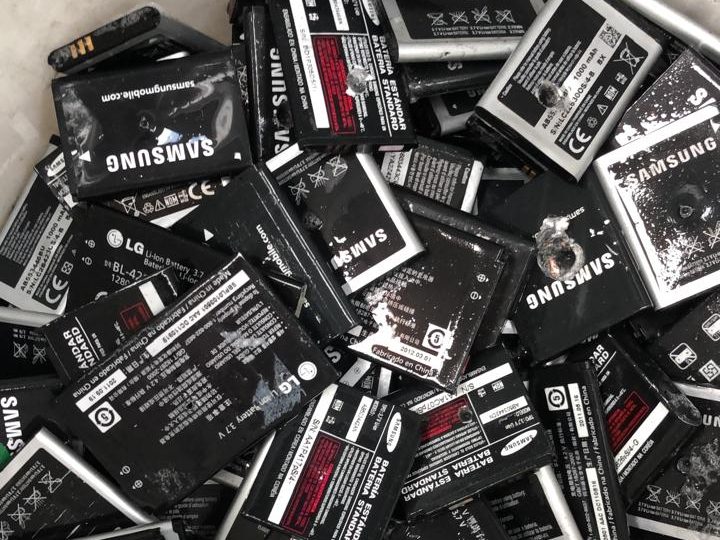
For offices, workshops, fleets, industrial plants and residential buildings we organize scheduled collection with a carrier authorized for hazardous waste. The usual setup is a container at an agreed point, collected by volume or on a calendar, with per-batch weighing and a valorization certificate for each pickup.
That certificate is what backs your hazardous waste reporting and your reporting under Chile’s Extended Producer Responsibility law (Ley REP, Law No. 20,920). If you are comparing suppliers, first check what to demand from an authorized lithium battery waste manager: the sanitary resolution, the role filed in SIDREP (Chile’s national hazardous-waste declaration and tracking system) and the final destination of the material are the three questions that save trouble later.
Individuals: municipal drop-off points
If you are an individual with two or three batteries, there are two routes. The first is a municipal clean point or collection campaign: many districts accept small batteries during limited hours, and it is worth confirming on the municipal website what they take before going. The second is to pool them with the batteries from your building, office or workshop and arrange a single drop-off with us — for a small volume, one grouped delivery is simpler for everyone.
Official information on waste management and EPR is published by the Ministry of the Environment (opens in a new tab).
What the battery decree would change
The Ministry of the Environment’s draft proposes that the collection network stop depending on goodwill. Two articles redraw the map for anyone trying to hand in a battery:
| Article | What it proposes | Status |
|---|---|---|
| Art. 28 | Collection points required according to each district’s population | Proposed |
| Art. 26 | Collection duty for retailers with more than 400 m² of floor area | Proposed |
| Art. 29 | Duty for vehicle workshops to hand waste to an authorized manager | Proposed |
| Art. 22 | Lithium-ion targets: none in the first two years, 15% in the third, 50% from the tenth | Proposed |
Swipe to see the full table
Source: Draft battery decree, Ministry of the Environment (Res. Ex. 821/2026) · 2026-09-18
None of this is in force yet: the ministry’s deadline to propose the decree was extended to January 29, 2027. Full timelines are on the battery decree page, and the market figures in the battery and solar module statistics for Chile.
What happens to your battery next
Every battery that comes in is tested before its route is decided. If the state of health (SOH) allows it, the pack is prepared for reuse: direct reuse above 90%, refurbishment above 80% and second life between 65% and 80%. Below 65% it goes to recycling: discharge, disassembly, milling into black mass and hydrometallurgy to recover the minerals. That process runs at our Santiago plant, under a sanitary authorization from the Seremi de Salud (Chile’s regional health authority) for the Santiago Metropolitan Region covering the hydrometallurgical process; the detail is on compliance and permits.
Source: Ecobaterías testing protocol · 2026-09-18. An in-house threshold, not a standard; reference methods IEC 63330-1 and UL 1974.
Intake and recycling are in operation. Testing, repair and second life run as a 2026–2027 pilot program (limited capacity): we work with limited batches and lead times agreed case by case.
The recovered cobalt sulfate goes back to mining: it was successfully tested at Codelco El Teniente’s hydrometallurgical plant (trials from November 2023; results published in July 2024), at 22% lower cost than the imported product and with 40% lower additive consumption.
Source: El Rancagüino · July 2024. The press report does not name the supplier; documentation identifying Ecobaterías is available under a confidentiality agreement.
See the detail under what happens to your battery next and, if your battery still works, on the testing and repair page.
Frequently asked questions
I have 3 laptop batteries — where do I take them in Santiago?
Message us on WhatsApp saying you have three laptop packs and we will confirm an intake slot at our Santiago plant. Bring them with the terminals covered in insulating tape and packed in a rigid box. There is no minimum quantity, but the time has to be arranged before you arrive.
Do you accept alkaline or car batteries?
No. Household alkaline batteries go to battery collection points, and automotive lead-acid batteries are handed to the managers of that circuit, which is already well established in Chile. We accept lithium-ion batteries of any size.
Do you charge to receive batteries?
The intake price is published on the services page and applies per metric ton. For one-off drop-offs of a few units, message us and we will confirm the terms before you come.
Can you collect outside Santiago?
Yes. Collection is arranged with a carrier authorized for hazardous waste anywhere in Chile. The cost depends on volume and distance, so we need the approximate quantity, the battery type and the location to come back with a proposal.
Which document do I receive afterwards?
An intake record with the weight of the batch and, once processed, the valorization certificate. That certificate is what backs your hazardous waste reporting and your reporting under Law No. 20,920.
Sources
- Library of the National Congress of Chile, Law No. 20,920 (EPR).
- Ministry of the Environment, draft battery decree (Res. Ex. 821/2026) and its regulatory impact assessment: market figures, recycling rates and articles 22, 26, 28 and 29.
- Supreme Decree (DS) 22/2025, Ministry of the Environment: collection targets for batteries and electrical and electronic equipment.
- Ecobaterías testing protocol: state-of-health thresholds, cut-off September 18, 2026.
- El Rancagüino, July 2024: results of recycled cobalt sulfate at the El Teniente hydrometallurgical plant.
Arrange your drop-off
Tell us which batteries you have, how many and where you are. We will confirm whether a plant drop-off or a scheduled collection suits you, and which documents you will receive.
- Process authorized by the Seremi de Salud RM (regional health authority)
- Cobalt sulfate tested at Codelco El Teniente: 22% lower cost
- A reply within 48 business hours
- A valorization certificate for your EPR reporting