Used solar modules: testing and reuse
How a decommissioned module is classified and when reuse beats recycling.
Photovoltaic module management
A decommissioned module does not go to recycling before it is tested: first we measure how much power it still delivers and classify the batch, and only what cannot go back into service is dismantled to recover glass, aluminum and metals. Every batch closes with a valorization certificate and transport traceability.
Ecobaterías tests, repairs and reuses lithium-ion batteries and solar modules before recycling them, and recycles what cannot be reused at its own plant in Santiago.
Updated: September 18, 2026
+56 9 4011 8111 · We reply within 48 business hours.
Source: Ecobaterías Solar Observatory · cut-off of 2026-09-11.
Recycling a module that still produces destroys value. That is why the batch goes to the laboratory first: it is measured in a solar simulator against a calibrated reference and classified module by module. Whatever clears the threshold goes back to the market through module testing and reuse; whatever does not is recycled. They are two routes of the same service, decided by the same test.
In a real decommissioning the split between the two routes is rarely what the owner expects: modules from a plant that changed technology are usually healthy, while modules from a plant with years of hail or poor handling are not. Testing settles the question with numbers.
Status reviewed on September 18, 2026. The pilot program works with limited batches and case-by-case lead times: we do not commit industrial capacity on lines that are not yet in full operation.
Classification is based on measured power against nameplate, using IEC 61215 and IEC 61730 as reference methods for performance and safety, and IEC TS 60904-13 for electroluminescence inspection. The classification is Ecobaterías’ own: the standards are the method, not a certification of ours.
| Class | Power against nameplate | Destination |
|---|---|---|
| P1 | ≥ 85% | Reuse with no restriction of use |
| P2 | 80–85% | Reuse in projects that accept lower output |
| P3 | 70–80% | Off-grid installations only |
| Recycling | < 70% | Recovery: glass, aluminum, laminate and metals |
Swipe to see the full table
Source: Ecobaterías testing protocol · 2026-09-18. Our own threshold, measured in a solar simulator against a calibrated reference; IEC 61215, IEC 61730 and IEC TS 60904-13 are cited as reference methods.
A module with cracked glass, extensive delamination or a damaged junction box does not enter that scale at all: it goes straight to recycling, with or without remaining power, because it cannot be safely reinstalled.
By mass, a crystalline module is mostly glass and aluminum. Dismantling first removes the aluminum frame and the junction box with its wiring; then the glass is separated; what remains is the laminate, which holds the silicon cell and the metals of the interconnection ribbons.
What is not recovered has to be stated too: polymer encapsulants and the module backsheet currently have no recovery outlet with an authorized final destination in Chile that we could offer, so they are managed as waste with a documented final destination. Promising a total recovery percentage would mean inventing a number.
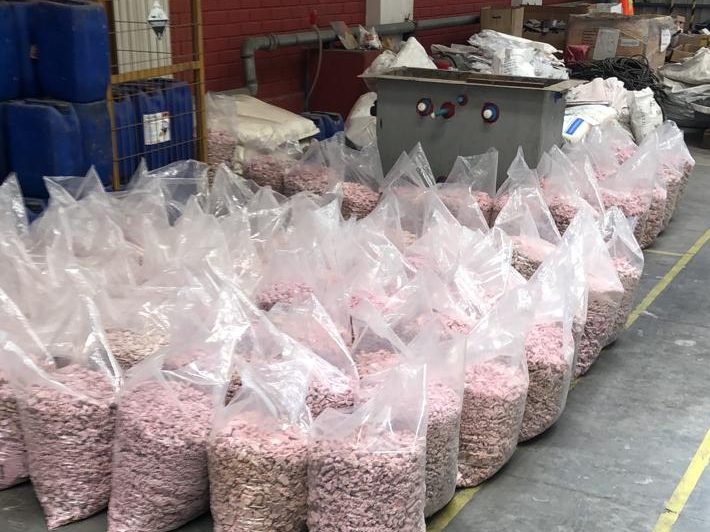
Until proven otherwise, a decommissioned module is handled as hazardous waste: authorized storage at origin, transport with a dispatch manifest, and an authorized final destination. Supreme Decree (DS) 148/2003 governs that circuit and requires a management plan once an installation generates 12 metric tons or more of hazardous waste per year.
Movements are declared in SIDREP, Chile’s national hazardous-waste declaration and tracking system, and the owner keeps the record of where each batch ended up. When characterization allows a fraction to be declassified — separated glass or aluminum, for instance — that fraction leaves the hazardous circuit and is documented separately.
Our role in that chain is the waste manager’s: we receive, recover and issue the document. The declaration itself is made by the waste holder, using what we hand over.
Supreme Decree (DS) 22/2025, published on May 7, 2026, sets collection and recovery targets for batteries, electrical and electronic equipment and photovoltaic modules, enforceable 24 months after publication, that is, from May 2028. For photovoltaic modules the series starts at 10% in the third year (2030) and reaches 50% in the tenth (2037), measured against the estimated waste of each year rather than against what was placed on the market.
That is the practical reason for the certificate: without a document proving how many modules were recovered and where, a producer has nothing to demonstrate its target with. Every batch we receive closes with a valorization certificate stating the number of modules, the mass received and the destination of each fraction.
Source: Supreme Decree 22/2025, Chilean Ministry of the Environment, published in the Diario Oficial on 2026-05-07 · 2026-09-18.
Most of Chile’s photovoltaic capacity sits far from Santiago, and moving broken modules 1,500 kilometers only to find out they were worthless is the worst version of this service. So testing can happen on site: the mobile laboratory classifies at the plant and only modules with a defined destination travel. On-site coverage reaches Antofagasta, Atacama, Tarapacá and Coquimbo in addition to the Santiago Metropolitan Region, within the 2026–2027 pilot program of our PV module line and with slots agreed batch by batch.
Testing runs at about 6 minutes per module, between 150 and 250 modules per day and shift. That is laboratory capacity, not a turnaround commitment: the real lead time of a batch depends on transport and on the owner’s window.
On volumes, plan with the curve rather than with a single owner: the early flow stays between 55,000 and 80,000 modules a year through 2029, then jumps to between 400,000 and 850,000 modules in the years when power purchase agreements expire (2030 and 2033–2035). The first relevant milestone is El Romero in 2030, with roughly 776,000 modules associated.
Source: Ecobaterías Solar Observatory · cut-off of 2026-09-11. The years correspond to power purchase agreement expiries, not to closures announced by their owners.
Module recycling is quoted per batch. The four variables that move the figure are the number of modules, their condition (intact or broken, framed or not), the distance to the plant and who performs the dismantling. We do not publish a per-module rate: it would be a number that does not survive contact with a real batch.
What is published is the intake price for lithium-ion batteries, a different service that does not apply to photovoltaic modules. For a batch of modules, the quote starts from the form or from WhatsApp with three data points: approximate quantity, condition and location.
The collection and recovery targets of Supreme Decree (DS) 22/2025 become enforceable 24 months after publication, that is, from May 2028. We summarize the rule rather than transcribe the article: the official text prevails over any paraphrase of ours.
Source: Supreme Decree 22/2025, Chilean Ministry of the Environment (Diario Oficial, 2026-05-07) · 2026-09-18.
Tell us how many, in what condition and where they are. We test first and recycle what can no longer operate.
How a decommissioned module is classified and when reuse beats recycling.
Figures, regulation and why photovoltaic end of life arrives earlier than expected.
Full scope of the service, battery intake price and coverage.