About us: a Chilean company for lithium batteries and solar panels
What we do today, what the Lampa plant did, who is behind the company and the status of each service.
EcoBaterías is a Chilean company that recycles, repairs and reuses lithium batteries and solar panels. It tests, repairs and refurbishes batteries and panels, gives them a second life when they still hold value and manages the recycling of the rest with authorized receiving facilities, with pickup coordinated with licensed hazardous-waste carriers anywhere in Chile. Its hydrometallurgical process comes from EcoMinería (Ecoprojects), a founding partner, which operated a plant in Lampa (Santiago Metropolitan Region) under a 2020 health permit from the Seremi de Salud RM (Chile’s regional health authority) issued in its name. Its new plant is under review by the Seremi de Salud RM.
Updated October 9, 2026
- Based in
- Santiago, Santiago Metropolitan Region
- Product lines
- Lithium-ion batteries (LFP, NMC, NCA, LCO and LTO) and photovoltaic modules
- Services
- Testing, repair, refurbishment, second life, recycling, collection and transport
- Customers
- Companies and individuals
- Coverage
- All of Chile, with pickup coordinated with licensed hazardous-waste carriers
- Lithium-ion battery recycling
- 22 UF per tonne + VAT (19%), managed with authorized receiving facilities; the UF is Chile’s inflation-indexed unit of account
- Origin
- Combines the solar experience of SolarPro Chile and the hydrometallurgical process of Ecoprojects (EcoMinería)
- Lampa plant
- Operated by EcoMinería (Ecoprojects), a founding partner, under a 2020 Seremi de Salud RM health permit issued in its name; no longer operating
- New plant
- Under review by the Seremi de Salud RM
- Reply
- Within 48 business hours
What does EcoBaterías do?
We work with two product lines, lithium-ion batteries and photovoltaic modules, in the same order for both: first we test, then we repair or refurbish what can be fixed, give a second life to what still holds value and manage the recycling of the rest. We serve companies and individuals, and we coordinate pickup with licensed hazardous-waste carriers anywhere in Chile.
Two definitions used throughout this page: state of health (SOH) is the capacity a battery retains compared with when it was new, as a percentage, and the BMS (battery management system) is the electronics that measure and protect the cells in a pack.
| Service | Lithium batteries | Solar panels |
|---|---|---|
| Testing | Testing and SOH certificate: BMS readout, insulation, capacity and impedance | Solar panel testing: electroluminescence, I-V curve, thermography and insulation |
| Repair | Battery repair: BMS, cells and modules, connectors, contactors and fuses | Panel repair: junction box, bypass diodes, connectors and cables |
| Refurbishment | Pack refurbishment: disassembly, testing of every module, replacement of weak ones and a capacity test | Refurbished panels: graded by measured power, labeled and sold |
| Second life and reuse | Second life: graded modules for stationary storage | Reuse of decommissioned panels: testing and grading by batch |
| Recycling | Battery recycling for companies: managed with authorized receiving facilities, at 22 UF/t + VAT, and a certificate from the authorized receiving facility for EPR reporting | Panel recycling: handling with authorized receiving facilities and a certificate from the receiving facility for Supreme Decree (DS) 22/2025 |
| Collection and transport | Collection and transport of batteries and panels: packaging by risk, shipping documents and pickup coordinated with licensed hazardous-waste carriers | |
Swipe to see the full table
Large-format cases have their own pages: end-of-life BESS (battery energy storage systems), electric bus batteries and solar plant repowering. The full overview is under all services.
We repair, refurbish and repurpose lithium-ion batteries only. NiMH, lead-acid and other chemistries are quoted separately. We do not repair inverters.
How do we decide what is repaired, reused or recycled?
With a measurement, not by eye. Every battery and every panel is tested, and the result sets the route according to our own thresholds. If the fault is isolated — a BMS, a diode, a junction box — it is repaired first and graded afterwards. The SEC (Superintendencia de Electricidad y Combustibles) is Chile’s electricity and fuels regulator.
| Line | Test result | Route |
|---|---|---|
| Batteries | SOH of 90% or more | Direct reuse in the same application |
| Batteries | SOH of 80% to 90% | Refurbishment for the same application |
| Batteries | SOH of 65% to 80% | Second life in stationary storage |
| Batteries | SOH below 65%, physical damage or cells discharged to 0 V | Recycling |
| Panels | Class P1: 85% or more of nameplate power | Reuse and sale |
| Panels | Class P2: 80% to 85% | Reuse and sale |
| Panels | Class P3: 70% to 80% | Off-grid uses, subject to SEC requirements |
| Panels | Below 70% or broken glass | Recycling |
Swipe to see the full table
Source: EcoBaterías test protocol · in-house thresholds, not a standard · 2026-09-26
A battery discharged to 0 V does not go back into service even if it recovers voltage: the risk of an internal short circuit is our criterion for sending it to recycling. A panel with broken glass is neither repaired nor sold. Testing takes 30 minutes to 6 hours per battery pack and about 6 minutes per photovoltaic module, with 50 to 100 modules per day.
Where does EcoBaterías come from?
EcoMinería (Ecoprojects), a founding partner of EcoBaterías, ran a hydrometallurgical lithium-battery recycling plant in Lampa under a 2020 health permit. While that plant operated, it closed the loop inside Chile: it received the battery, recovered the mineral and returned it to mining.
As market evidence, the hydrometallurgical plant of Codelco El Teniente successfully tested recycled cobalt sulfate, delivered in solution (testing from November 2023; results published in July 2024), and those results are reported in El Rancagüino’s article of July 15, 2024 (opens in a new tab). The article does not name the supplier.
Almost no lithium-ion battery is recycled in Chile today. The Ministry of the Environment estimates 1,100 t of lithium-ion battery waste for 2026, with a recycling rate close to zero, while lead-acid batteries — a far older chemistry — are recycled at around 90%. What is missing is infrastructure able to receive that waste, treat it inside the country and return a sellable product.
Source: Regulatory impact assessment of the draft battery decree, Ministry of the Environment (opens in a new tab) · 2026-09-18
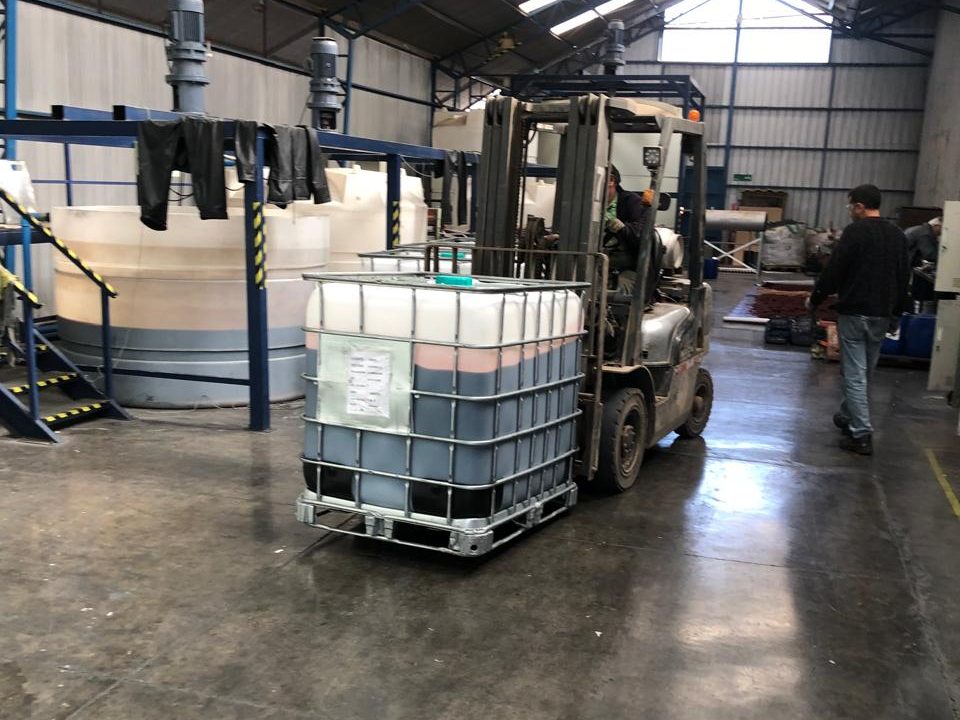
EcoBaterías, EcoMinería and SolarPro: who is who
EcoBaterías combines the track records of two companies that bring different, verifiable capabilities. To avoid confusion, this is what each one does:
- SolarPro Chile
- Engineering and development of solar projects. Brings renewable-energy and project execution experience. Own website: solarprochile.com (opens in a new tab).
- Ecoprojects (EcoMinería)
- Industrial waste management and hydrometallurgy. A founding partner of EcoBaterías: brings the hydrometallurgical process it ran at its Lampa plant, under a 2020 health permit issued in its name.
- EcoBaterías
- The company that combines both track records to test, repair, refurbish, reuse and manage the recycling of lithium batteries and photovoltaic modules in Chile.
The detailed corporate structure — shareholdings and legal representation — is not published here: it is delivered, documented, to investors and clients who request it within a formal process. We would rather not publish a figure we cannot back with the document in hand.
EcoBaterías was founded by Ecoprojects (opens in a new tab, in Spanish) and SolarPro (opens in a new tab, in Spanish), companies led by Álvaro Cruz and Carlos Jofré (opens in a new tab). The list of the group companies, with each one’s official website, is on Carlos Jofré’s group companies page (opens in a new tab, in Spanish).
What did the Lampa plant do, and what happens today to what is recycled?
The Lampa plant, Santiago Metropolitan Region, operated by EcoMinería (Ecoprojects), a founding partner of EcoBaterías, covered the full chain: intake and sorting, safe discharge and dismantling, milling into black mass, leaching, purification, crystallization and dispatch. The products leaving the plant were cobalt and nickel sulfate, copper and aluminum. The new plant is under review by the Seremi de Salud RM. The step-by-step route is on the lithium battery recycling process page.
Black mass is the black powder left after milling the cells: it concentrates the cathode metals and the graphite. Today, for whatever can no longer be used, we manage its valorization with authorized receiving facilities, in Chile or in OECD countries where applicable; the authorized receiving facility closes the SIDREP declaration and issues the valorization certificate. SIDREP is Chile’s national hazardous-waste declaration and tracking system, used to declare and follow every shipment of hazardous waste. Before recycling, we test: only what fails the thresholds in the table above is recycled. That is the order set by the waste hierarchy of Chile’s Extended Producer Responsibility law (Ley REP, Law No. 20,920), and it also recovers more value per tonne.
- 22%lower cost than imported cobalt sulfate, measured at Codelco El Teniente
- 40%lower additive consumption at the hydrometallurgical plant
- 1 daily additioninstead of three: a simpler operation, because the product is delivered as a liquid
Source: El Rancagüino, “El Teniente successfully tests recycled cobalt sulfate” (opens in a new tab) · 2024-07-15. The article does not name the supplier.
Permits and compliance
The Lampa plant, operated by EcoMinería (Ecoprojects), a founding partner of EcoBaterías, held a 2020 health permit from the Seremi de Salud of the Santiago Metropolitan Region (Chile’s regional health authority) issued in EcoMinería’s name, and the new plant is under review by that same authority. End-of-life lithium batteries are handled as hazardous waste unless a characterization shows otherwise. Chile’s hazardous waste regulation, Supreme Decree (DS) 148/2003, applies: anyone generating more than 12 tonnes a year of this waste (or more than 12 kg if acutely toxic) must have a management plan, and every shipment travels with licensed transport and is declared. Traceability is documented batch by batch to support the declaration of whoever hands over the waste.
Source: DS 148/2003, arts. 25, 27 and 36, Library of the National Congress of Chile (opens in a new tab) · 2026-09-26
We do not publish resolution numbers or dates, certifications or client names on this page. When a client or an investor needs to verify something, we provide it documented. The documents we deliver with each service are listed under compliance, permits and documents, and the regulatory path of the sector — Law 20,920, DS 22/2025 and the draft battery decree — is explained in market and regulation.
Milestones with dates
- November 2023 Testing of recycled cobalt sulfate begins as an additive at the hydrometallurgical plant of Codelco El Teniente, replacing the imported solid product (market evidence; the article reporting it does not name the supplier).
- July 2024 El Rancagüino publishes the results of those tests: 22% lower cost, 40% lower additive consumption and a single daily addition.
- 2026 Testing, repair, refurbishment and reuse services for batteries and solar panels open.
This list only includes milestones we can support with a published source or verifiable documentation. Incorporation dates and resolution dates are not included until they are confirmed.
What is the status of each service?
We publish the status of each capability so you know what you can contract today. Testing: available. Recycling and final disposal: through authorized receiving facilities; own capacity in the permitting process.
| Capability | Status |
|---|---|
| Lithium-ion battery recycling price (22 UF per tonne + VAT) | Through authorized receiving facilities |
| Collection and transport, coordinated with licensed hazardous-waste carriers | Available |
| Battery testing and SOH certificate | Available |
| Lithium battery repair | Available |
| Battery refurbishment | Available |
| Second-life batteries | Available |
| Battery recycling: coordinated pickup, handling with authorized receiving facilities and a certificate from the authorized receiving facility | Through authorized receiving facilities |
| Solar panel testing | Available |
| Solar panel repair | Available |
| Panel refurbishment and sale of refurbished modules | Available |
| Reuse of decommissioned panels | Available |
| Panel recycling: coordinated pickup, handling with authorized receiving facilities and a certificate from the authorized receiving facility | Through authorized receiving facilities |
| Recycling at a plant of our own (new plant) | Under review by the Seremi de Salud RM |
Swipe to see the full table
Source: EcoBaterías datos/empresa.json, status reviewed on 2026-10-09.
Where should you start?
If you have a batch in storage, start with collection and transport: we tell you how to pack it and which documents your company issues. If a battery or a panel fails but looks recoverable, start with battery testing or solar panel testing. If you want to see the published evidence on recycled cobalt sulfate, read about the test at Codelco El Teniente. General questions are covered in the FAQ and the glossary. We reply within 48 business hours.
Sources: Law 20,920 (EPR), Library of the National Congress of Chile (opens in a new tab) · Chilean hazardous waste regulation, DS 148/2003 (opens in a new tab) · Regulatory impact assessment of the draft battery decree, Ministry of the Environment (Res. Ex. 821/2026) · El Rancagüino, 2024-07-15 (opens in a new tab) · EcoBaterías test protocol (in-house thresholds, not a standard).
Let’s talk about your batteries or your panels
Tell us what you have and in what condition: we will tell you what gets repaired, what gets refurbished, what moves to second life and what gets recycled, and how it is documented for your EPR reporting.
- Reply within 48 business hours
- Pickup coordinated with licensed hazardous-waste carriers across Chile
- Technical report for every batch
- In-house testing lab for batteries and panels