Ecobaterías tests, repairs and reuses lithium-ion batteries and solar modules before recycling them, and recycles what cannot be reused at its own plant in Santiago.
Updated: September 18, 2026 · Reviewed by the Ecobaterías technical team
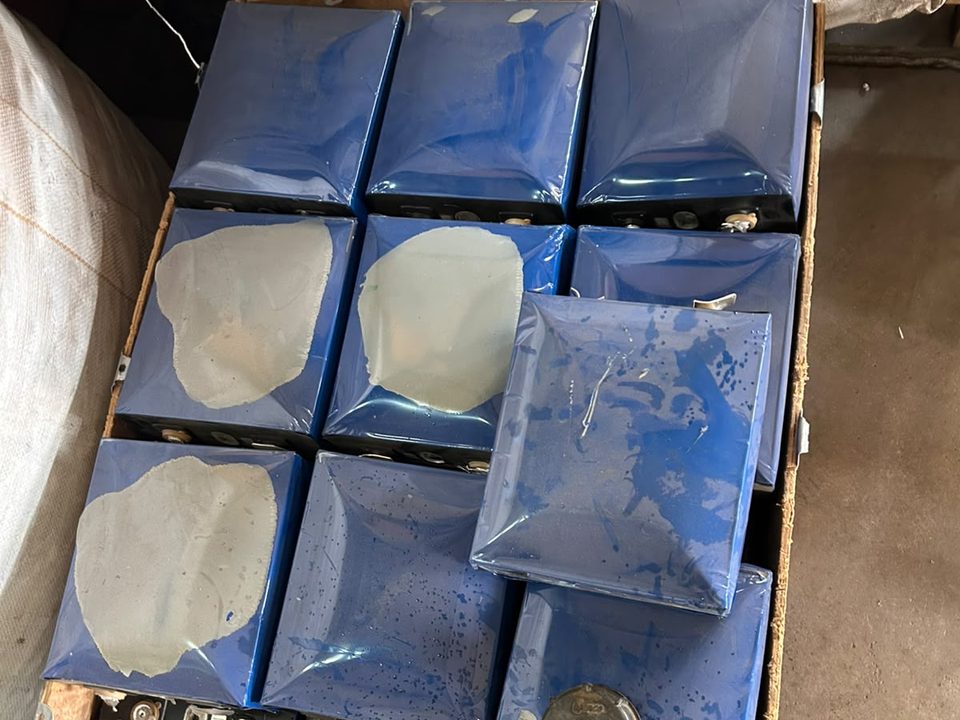
Large-format cells at intake: every batch arrives with its own code and test record.
On this page
A BESS reaches the end of its useful life when its available energy no longer meets the contract, not when it stops working. Ecobaterías tests decommissioned modules on site, grades them rack by rack and decides between repair, second life and recycling, with authorized collection and a valorization certificate for EPR reporting.
Input
Decommissioned storage racks, modules and containers, under warranty or after a capacity upgrade
Testing
Management-system readout, insulation, internal resistance, capacity and impedance spectroscopy (EIS)
Thresholds
SOH ≥ 80% repair · 65–80% second life · < 65% recycling
Time
From 30 minutes to 6 hours per pack or module, depending on test depth
Transport
Class 9, with an authorized carrier and a declaration when the module is waste
Output
Per-rack and per-module report, plus a per-batch valorization certificate
Intuition says a storage system is retired when it stops working. In practice the opposite happens: the system keeps running, but its available energy falls below what the contract or the revenue model requires, and an intervention becomes necessary. The modules that reach our laboratory almost always come from one of four situations:
Warranty claims. A rack falls below the committed degradation curve and the manufacturer or integrator needs an independent failure analysis.
Capacity upgrades. When a plant is expanded, whole racks are replaced to keep the block homogeneous, and the outgoing racks still hold usable energy.
Architecture or supplier change. The system is reconfigured and modules are left unused, undamaged and without a destination.
Incidents. An electrical fault, a thermal event or mechanical damage forces part of the system to be segregated, and it must be graded before it is moved.
In the first three cases the material is not scrap: it is a heterogeneous batch that needs measurement. In the fourth, safety comes first, and grading decides what can be moved and how.
How much storage Chile has, and what it implies
Battery storage is no longer marginal in the Chilean power system. The Coordinador Eléctrico Nacional reported 3,072 MW and 13,528 MWh in operation and testing in April 2026, a figure that includes units still under test. For the end of that same year the grid operator projects 5,081 MW and 18,643 MWh, and the National Energy Commission more than 20,000 MWh; these are published projections, not installed capacity, and they must be read that way.
What matters for end of life is not the total but its shape: a fleet that grows fast produces, a few years later, a steady flow of modules removed through warranty, expansion and reconfiguration. That flow starts before the first system completes its design life, and in Chile it has no obvious destination today.
On-site testing: EIS and grading by rack and module
Moving a full container to find out what is inside is expensive and, with modules of unknown condition, risky. So the work starts at the client’s site, before anything is touched:
Document and safety reviewManagement-system logs, alarms, thermal and insulation history are reviewed, and the working perimeter is defined.
Electrical measurement per rackOpen-circuit voltage, module-to-module spread, insulation to ground and internal resistance: the first separation between healthy and suspect racks happens here, with no dismantling.
Impedance spectroscopy (EIS) per moduleEIS grades modules in minutes and detects degradation that nominal capacity does not reveal. It is the tool that makes grading hundreds of modules in one campaign feasible.
Capacity testing on a sampleA representative sample per rack is selected and put through a full charge and discharge cycle to anchor the EIS results to a real energy measurement.
Self-discharge and cross-checkVoltage drop at rest over 24 hours is measured on doubtful modules; it is the filter that catches defects you cannot see.
Grading and collection planEvery module is assigned a route and every batch a transport. Only what already has a destination and paperwork is moved.
In a storage plant you do not retire the system: you retire the racks that stopped performing. The difference between the two is the whole recoverable value.
Testing times and laboratory capacity
We publish what we measure and we do not turn laboratory times into delivery promises per megawatt-hour: real campaign throughput depends on site access, system architecture and the share of modules that need full testing.
Reference times of the testing protocol
Stage
Scope
Reference time
Rapid electrical test
Per rack, no dismantling
30–60 min
EIS grading
Per module
Minutes per module
Capacity test
Per sample pack or module
2–6 h
Self-discharge
Per doubtful module
24 h at rest
Swipe to see the full table
Source: Ecobaterías testing protocol (laboratory capacity, not a contractual lead-time commitment) · September 18, 2026.
The four routes of a BESS module
Grading always ends in one of these four routes, the same ones we apply to any lithium battery:
A
Direct reuse
SOH ≥ 90%. The module returns to the same or an equivalent system, with a state-of-health certificate.
B
Repair and return
SOH ≥ 80%. The module or its electronics are repaired, retested and returned to the block.
SOH < 65% or a safety fault. Discharge, dismantling and hydrometallurgy in Santiago, with a valorization certificate.
Duties of the system owner
A decommissioned storage module is hazardous waste until proven otherwise. These are the obligations worth settling before collection starts:
Handling as hazardous waste. Supreme Decree (DS) 148/2003 on hazardous-waste management requires authorized storage, transport and declaration, and a management plan above 12 tonnes per year.
Class 9 transport. Lithium-ion batteries travel as class 9 dangerous goods, with controlled preparation, packaging and state of charge.
Proposed annual declaration (Art. 40). The draft battery decree proposes an annual declaration before May 31 through the RETC single window for industrial consumers and storage installations above 1 MWh.
Preparation for reuse (Art. 22). The same draft proposes that at least 30% of the lithium-ion target be met through preparation for reuse, which gives regulatory value to grading before recycling.
Law in force. All of the above rests on Chile’s Extended Producer Responsibility law (Ley REP, Law No. 20,920); the battery targets decree does not exist yet and the ministry’s deadline to propose it is 2027-01-29.
We arrange on-site testing and collection with authorized transport from the Metropolitan Region and from the regions of Antofagasta, Atacama, Tarapacá and Coquimbo. Graded material travels to the Santiago plant, where whatever goes to recycling is processed and whatever continues to second life is prepared.
Campaigns are organized in batches: each batch leaves with its file, its code and its transport document, and none is moved before it has been graded. That discipline is what makes it possible to issue a valorization certificate that survives an audit.
What we deliver
Test report per rack and per module, with measured energy, internal resistance, spread and observations.
Grading by route, with the number of modules in each one and the destination of each batch.
Traceability file per batch: code, weight, date, transport and destination.
Valorization certificate for whatever enters recycling, to support the producer’s reporting.
Material that reaches recycling is processed at our hydrometallurgical plant in Santiago, which holds a health permit from the Seremi de Salud (Chile’s regional health authority) of the Metropolitan Region for the hydrometallurgical process (see compliance and permits). It yields cobalt and nickel sulfate, copper, aluminum and graphite, which return to industry; the recycled cobalt sulfate was successfully tested at the Codelco El Teniente hydrometallurgy plant (trials from November 2023; results published in July 2024), with 22% lower cost and 40% lower consumption than imported sulfate.
Source: El Rancagüino, July 15, 2024. The article does not name the supplier; the documentation identifying Ecobaterías is available under a confidentiality agreement.
Status of each service line
Battery intake and recycling
In operation
Battery diagnostics and repair
2026–2027 pilot program (limited capacity)
PV module line
2026–2027 pilot program (limited capacity)
Stationary second life
2026–2027 pilot program (limited capacity)
Status reviewed on September 18, 2026. The pilot program works with limited batches and case-by-case lead times: we do not commit industrial capacity on lines that are not yet in full operation.
How to engage us
BackgroundYou tell us the technology, number of racks, installed MWh, commissioning year and location.
Site visit and testingWe review the management-system logs and measure rack by rack.
Report and gradingYou receive the result by route, with the destination and the document that applies to each batch.
CollectionWe arrange authorized transport and the waste declaration where it applies.
Close-outValorization certificate for what is recycled and a usable-energy label for what continues to second life.
Frequently asked questions
When is a BESS considered to have reached end of life?
When the available energy stops meeting the contract or project commitment, not when the system shuts down. That point is reached earlier in the hardest-worked racks, so the usual case is not retiring the whole system but specific racks or modules. That is why testing is done rack by rack and module by module.
Does every module have to go to recycling?
No. A module removed from a BESS may be above 80% state of health and return to the same system after repair, or land between 65% and 80% and move to stationary second life. Only below 65%, or with a safety fault, does it go to recycling at our hydrometallurgical plant.
Does the storage system have to be declared to the Ministry of the Environment?
The draft battery decree proposes an annual declaration before May 31 through the RETC single window for industrial consumers and for storage installations above 1 MWh. It is a proposal under consultation: the ministry’s deadline to propose the decree is 2027-01-29.
How are decommissioned modules transported?
As class 9 dangerous goods and, when the module is waste, with an authorized carrier and a declaration in the national hazardous-waste system. Preparation includes protected terminals, suitable packaging and a controlled state of charge before loading.
Can you test without dismantling the system?
Yes. On-site testing starts with the management-system readout and with electrical measurements per rack, with no dismantling. Only what the test flags is dismantled, and only what already has a defined route leaves the site.
What documentation is issued at the end?
A test report per rack and per module, the traceability file for each batch and the valorization certificate for whatever enters recycling, which supports the producer’s reporting under Law No. 20,920.