Direct reuse
SOH at or above 90%: the pack returns to its original application.
Compliance
Ecobaterías is a Chilean waste manager for lithium batteries and photovoltaic modules: intake, testing, recovery, and a valorization and traceability certificate for reporting under Chile’s Extended Producer Responsibility law (Ley REP, Law No. 20,920).
Updated September 18, 2026 · Reviewed by the Ecobaterías technical team
An authorized lithium battery waste manager is a company allowed to receive, transport and recover that hazardous waste under a valid sanitary authorization. Before you sign, ask for the full resolution, confirm whether the company is the final destination or an intermediary, and require per-batch weighing, SIDREP filing and a valorization certificate.
In Chile, lithium battery waste is handled as hazardous waste. The rule in force, Supreme Decree (DS) 148/2003, requires every generator to hold a management plan from 12 metric tons per year and to hand the waste only to facilities authorized to receive it.
Source: Hazardous waste regulation, DS 148/2003 (Library of the National Congress of Chile) · 2026-09-18
That authorization is not a generic seal. It is a resolution naming the facility, its address, the waste streams it may receive, the operations it may perform (storage, treatment, recovery) and its capacity. Ask for the whole document and check four things: that it is current, that the address matches the plant your material will actually reach, that your waste stream is named, and that the authorized operation is the one being sold to you.
Ecobaterías operates under a sanitary authorization from the Seremi de Salud (Chile’s regional health authority) for the Santiago Metropolitan Region covering the hydrometallurgical process. You can request the document and the process data sheet before contracting; see also compliance and permits.
An intermediary stores and transfers: it receives your battery and sends it to a third party. A final destination recovers or disposes of it. The distinction matters because your documentary responsibility does not end when the truck leaves your yard — it ends when the waste reaches its final destination and someone certifies what was done with it.
Always ask where the material physically ends up and who signs the certificate. If the answer involves an export, also ask for the transboundary movement authorization: the Basel Convention subjects this waste to prior notification and to the consent of the receiving country.
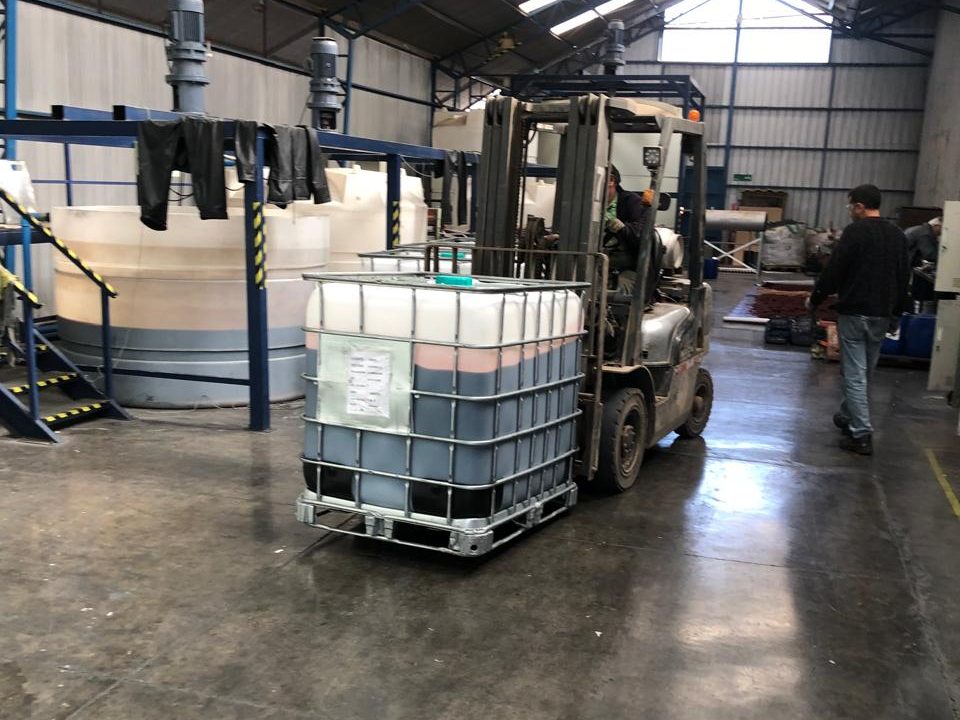
The cobalt sulfate produced at that plant was successfully tested at Codelco El Teniente’s hydrometallurgical plant (trials from November 2023; results published in July 2024): 22% cheaper than the imported product and 40% lower additive consumption, with a single daily addition.
Source: El Rancagüino · July 2024. The press report does not name the supplier; documentation identifying Ecobaterías is available under a confidentiality agreement.
Traceability is not a talking point: it is a chain of documents anyone can audit. These are the links to require in the contract.
If a supplier hands you only an invoice and a confirmation email, you do not have traceability: you have a pickup.
The Ministry of the Environment’s draft battery decree proposes an annual filing by May 31 through the RETC single window (Art. 40), covering industrial consumers and storage installations above 1 MWh. The text is still in process: the ministry’s deadline to propose the decree was extended to January 29, 2027.
Source: Draft battery decree, Ministry of the Environment (Res. Ex. 821/2026) · 2026-09-18
In the meantime, what is enforceable today remains Law No. 20,920 and DS 148/2003. Preparing early is cheap: a company that already weighs per batch and keeps certificates will not have to reconstruct a year of pickups when the obligation takes effect. Deadlines and targets by category are covered on the battery decree page and, for photovoltaic modules, under Supreme Decree (DS) 22/2025.
For lithium-ion batteries, the draft decree proposes no target in the first two years, 15% in the third and 50% from the tenth, with at least 30% of the target met through preparation for reuse.
Source: Draft battery decree, Ministry of the Environment (Res. Ex. 821/2026) · 2026-09-18
That changes what you should ask of your waste manager: shredding is no longer enough. You need one able to test every pack and assign a route against a written threshold. Ours is: state of health (SOH) at or above 90% for direct reuse, at or above 80% for refurbishment, between 65% and 80% for second life, and below 65% for recycling.
Source: Ecobaterías testing protocol · 2026-09-18. An in-house threshold, not a standard; reference methods IEC 63330-1 and UL 1974.
SOH at or above 90%: the pack returns to its original application.
SOH at or above 80%: modules or cells are replaced and the pack is rebalanced.
SOH between 65% and 80%: the pack moves to a less demanding stationary use.
SOH below 65%: discharge, disassembly, milling and mineral recovery.
Intake and recycling are in operation. Testing, repair and second life run as a 2026–2027 pilot program (limited capacity): we work with limited batches and lead times agreed case by case.
For a large fleet, start with lithium battery testing before deciding what gets recycled.
Lithium-ion batteries travel as class 9 dangerous goods. Require a carrier authorized for hazardous waste, terminals insulated one by one, packaging that prevents short circuits and load movement, and the manifest that accompanies every shipment. A damaged, swollen or leaking battery does not travel like a healthy one: flag it before the pickup so it can be packed separately.
Never store damaged packs next to combustible material or in the open. If you are unsure about a battery’s condition, ask us for the storage guidance before moving it.
We work as the final destination: we receive, test, recover and document. With every batch we issue an intake record with weighing, a valorization certificate, the SIDREP filing and the destination report for recovered materials. Our intake price is published: see it on the services page without asking for a quote.
To compare market figures first, they are gathered in the battery and solar module statistics for Chile and on the market and regulation page. If you only need to drop off a small volume, the short route is where to recycle lithium batteries in Chile.
Ask for the full sanitary resolution of the facility that will receive the waste and check four items: validity, address, authorized waste streams and permitted operations. If the document does not name your battery type or the operation being offered, that authorization does not cover your delivery.
An intermediary stores and transfers the waste to a third party; the final destination recovers or disposes of it and certifies what was done. If you hire an intermediary, ask in writing who closes the chain and require the certificate issued by that final destination.
The per-batch valorization certificate, together with the weighing record and the SIDREP filing. An invoice evidences a payment, not a treatment: it does not replace the certificate in an inspection or in a customer audit.
No. The draft is still in process and the Ministry of the Environment’s deadline to propose the decree was extended to January 29, 2027. What is enforceable today is Law No. 20,920 and DS 148/2003; the draft tells you which documents will be requested later.
Yes, with separate packaging and transport. Tell us before the pickup so we can explain how to isolate them from the rest of the load: a battery showing leakage, deformation or heating cannot travel alongside healthy packs.
Tell us which batteries you have, in what condition and where they are. We reply with the documentation backing every step and with the applicable intake price.