Direct reuse
SOH ≥ 90%. The pack goes back to its original application.
Urban mining
EcoBaterías is a Chilean company that recycles, repairs and reuses lithium batteries and solar panels.
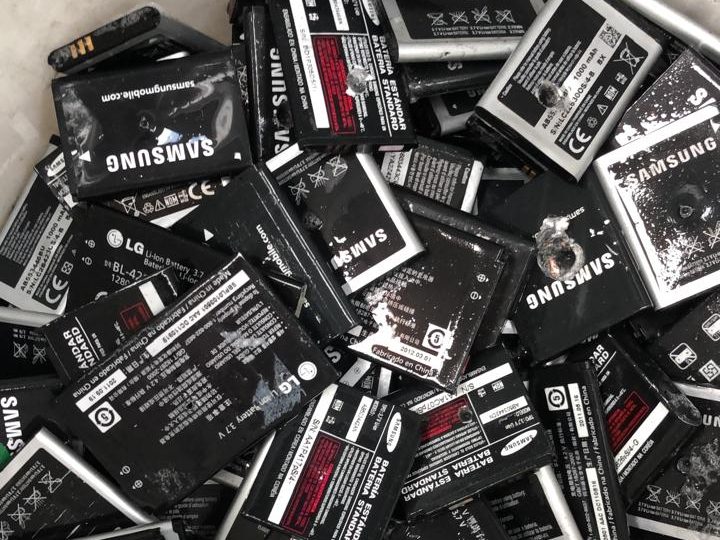
Urban mining means recovering metals that were already extracted once, from end-of-life products. A lithium battery is an ore that arrives crushed, hauled and concentrated by another industry: nickel, cobalt and manganese are already combined in the cathode. In Chile the resource keeps growing; what is missing is recovery capacity.
Updated October 9, 2026 · Reviewed by the EcoBaterías technical team.
Chile knows mining as few countries do. But the fastest-growing deposit is not in the Andes: it is in office drawers, importers’ warehouses, workshop yards and electronic scrap containers. Urban mining means recovering the metals we already extracted once, instead of extracting them from the ground again.
The phrase sounds like a metaphor, yet it describes rather precisely what happens in a recycling plant: there is a feed material with a given grade, there are comminution stages, there is leaching, there is purification and there is a mineral product with a specification at the other end. What changes is the origin of the material and, above all, what no longer needs doing.
The essential difference from a natural deposit is not only grade, it is work already done. To take a metal from rock to a cathode you must drill, blast, load, haul, crush, grind and concentrate. An end-of-life battery arrives with all of those stages resolved by another industry: nickel, cobalt and manganese are already combined in the active cathode material, in a known proportion written into the cell’s commercial name.
That proportion is definitional, not an estimate: an NMC 622 cell declares a 6:2:2 molar ratio between nickel, manganese and cobalt; an LCO concentrates cobalt above any other chemistry; an LFP contributes no nickel and no cobalt, but does contribute lithium and the current-collector metals. What each one holds, and how much of that content is actually paid for, is developed in black mass: what it is and what it is worth.
There is a second advantage, less often mentioned: urban material needs no concession, no exploration and no mine development. It arrives by truck, with its waybill, and is weighed on intake. What it does need is a health authorization to be processed, because an end-of-life battery is handled as hazardous waste under Supreme Decree (DS) 148 unless a characterization shows otherwise, and only a licensed hazardous-waste manager in Chile may receive it.
The size of the Chilean urban deposit is known with reasonable precision, because the Ministry of the Environment itself estimated it while preparing the draft battery decree.
| Category | Units placed on the market | Estimated waste | Current recycling rate |
|---|---|---|---|
| Lithium-ion | 396,000 | 1,100 t | ≈0% |
| Lead-acid | 7,800,000 | 44,400 t | ≈90% |
Swipe to see the full table
Source: regulatory impact assessment of the draft battery decree, Ministry of the Environment (Res. Ex. 821/2026) (opens in a new tab) · 2026-09-18
The contrast between the two rows is the important figure, and it should not be read as a defeat: lead-acid is recycled almost completely because it has had decades to build its chain, with collection points, specialized transport and smelters waiting for it. Lithium-ion is not recycled because that chain does not exist yet, not because the material is worthless. That asymmetry is the most honest argument for building the infrastructure now.
Source: regulatory impact assessment of the draft battery decree, Ministry of the Environment (Res. Ex. 821/2026) (opens in a new tab) · 2026-09-18
There is an understandable temptation in this story: if the battery is ore, grind it as soon as possible. That is a mistake, and it also runs against where regulation is heading. The draft decree proposes that at least 30% of the lithium-ion target be met through preparation for reuse rather than recycling. Put plainly: the law will push operators to exhaust service life before recovering the metal.
That is why the first step of our process is not the mill but the test. The pack’s state of health defines the route:
SOH ≥ 90%. The pack goes back to its original application.
SOH ≥ 80%. Weak modules are replaced and the pack is rebalanced.
SOH 65–80%. Reconfigured for stationary storage.
SOH < 65%. Goes to recovery and the mineral is extracted.
Source: EcoBaterías testing protocol · in-house thresholds, with IEC 63330-1 and UL 1974 as reference standards · 2026-09-18
All four routes are available today as services: lithium battery testing and repair for direct reuse, pack refurbishment, second-life batteries and lithium battery recycling, with pickup coordinated with licensed hazardous-waste carriers.
Chile has the growing flow, it has the regulatory framework and it has a very concrete local demand: copper mining consumes inputs that are imported today and that can be produced from recovered material. What was missing was the plant. That loop has already been run inside Chile at the Lampa plant, operated by EcoMinería (Ecoprojects), a founding partner of EcoBaterías, under a 2020 health permit from the Seremi de Salud of the Santiago Metropolitan Region (Chile’s regional health authority) issued in its name: it received the battery and recovered the mineral. EcoBaterías’ new plant is under review by the Seremi de Salud RM; meanwhile, EcoBaterías coordinates pickup with licensed hazardous-waste carriers and manages the recycling of lithium-ion batteries with authorized receiving facilities; the authorized receiving facility closes the SIDREP declaration and issues the valorization certificate for every batch.
That the loop can be closed is not a rhetorical figure: recycled cobalt sulfate was successfully tested at the hydrometallurgical plant of Codelco El Teniente (testing from November 2023; results published in July 2024, according to El Rancagüino, July 15, 2024): 22% lower cost and 40% lower consumption than imported sulfate, with one daily addition instead of three. The article does not name the supplier. The record of the trial, with its caveats, is in the recycled cobalt sulfate case at El Teniente.
For anyone holding accumulated material the path is short: check what the complete guide to Chile’s EPR law for batteries requires, see where to recycle lithium batteries in Chile by type and volume or, for a company batch, get a quote for lithium battery recycling for companies, and —if there are decommissioned photovoltaic modules too— follow the calendar of Supreme Decree (DS) 22/2025 and the solar panel targets. The full market scenarios are in the Chilean market for batteries and critical minerals.
Written by the EcoBaterías technical team. The flow figures come from the regulatory impact assessment of the Ministry of the Environment’s draft battery decree and are collected in the canonical figures table, with their cut-off date.
Tell us which batteries you have, how many and where they are. We reply within 48 business hours with the route —reuse or recovery—, pickup coordinated with licensed hazardous-waste carriers and the authorized receiving facility’s certificate you need for reporting.
Testing, repair, refurbishment, second life, recycling and coordinated pickup, with a valorization certificate from the authorized receiving facility for every batch.
Flow scenarios, mining demand and the regulatory calendar, with sources.
The intermediate where a battery’s metal value concentrates, chemistry by chemistry.