How a lithium battery is recycled
Every stage of the process, from pack intake to salt crystallization, with real photographs.
Process
EcoBaterías is a Chilean company that recycles, repairs and reuses lithium batteries and solar panels.
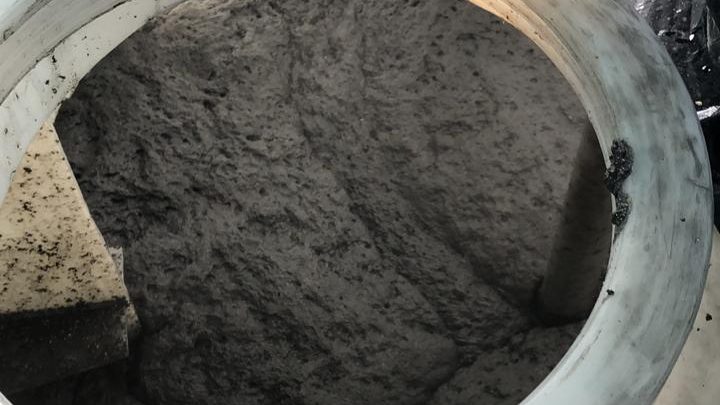
Black mass is the dark powder left after a lithium-ion battery is discharged, dismantled and its cells are ground. It concentrates the active cathode material and the anode graphite, that is, the battery’s lithium, nickel, cobalt and manganese. It is an intermediate product: its value is only realized once hydrometallurgy turns it into mineral salts with a specification.
Updated October 9, 2026 · Reviewed by the EcoBaterías technical team.
Black mass is not a mineral you find in nature: it is an intermediate product that recycling itself manufactures. An end-of-life lithium-ion battery is fully discharged, dismantled into modules and cells, stripped of its metal casing, wiring and control electronics, and only then do the cells go into a controlled grinding step. What comes out is a dark, dense powder in which the active cathode material and the anode graphite are mixed together. That powder is black mass.
Because it is an intermediate, its price is famously hard to pin down: it is no longer ordinary waste, but it is not yet a mineral product the industry can buy. It is the form in which battery material becomes transportable, samplable and analyzable batch by batch, which is exactly what a buyer needs in order to pay for its metal content. Everything that happens before —discharge, dismantling and grinding— is part of the hydrometallurgical lithium battery recycling process, and only a licensed hazardous-waste manager in Chile may do it, because an end-of-life battery is handled as hazardous waste under Supreme Decree (DS) 148 unless a characterization shows otherwise.
One common misunderstanding is worth clearing up: black mass is not “the ground-up battery.” In a complete battery a large share of the mass is steel, aluminum, plastic and copper from the casing and the wiring, all of which is separated beforehand and follows its own recycling route. Black mass is only the active fraction, which is why it concentrates so much value per kilogram. In Chile, Core-4, a pretreatment line that produces black mass (in Spanish) (opens in a new tab), brings together four units (crushing, screening, flotation and filtering) that recover black mass, copper and aluminum from end-of-life lithium batteries; it is an ANID Startup Ciencia project of NeuroVentas Chile. The acronyms in this guide (NMC, LFP, SOH) are defined in the technical glossary.
There is no single black mass. Its composition depends on the cathode chemistry of the cells that entered the mill, and that chemistry is written into the battery’s commercial name. The acronyms are not marketing: they describe the proportion of metals in the active material.
| Chemistry | What the acronym means | Valuable metals in the black mass | Where it is found |
|---|---|---|---|
| NMC | Nickel manganese cobalt oxide; the number (111, 622, 811) is the molar ratio between the three | Nickel, cobalt, manganese and lithium | Electric vehicles, power tools, storage |
| NCA | Nickel cobalt aluminum oxide | Nickel, cobalt and lithium | Some electric vehicles |
| LCO | Lithium cobalt oxide | Cobalt and lithium, in the highest proportion of any chemistry | Phones, laptops, consumer electronics |
| LFP | Lithium iron phosphate | Lithium; no nickel and no cobalt | Buses, stationary storage, entry-level vehicles |
| LMO | Lithium manganese oxide | Manganese and lithium | Power tools, micromobility, blends with NMC |
Swipe to see the full table
The practical consequence is awkward for anyone stockpiling mixed material: a ton of black mass from mobile phones and a ton from electric buses are not worth the same and are not processed the same way, even though both look like an indistinguishable black powder. That is why sorting by chemistry starts long before grinding, while the pack is still intact and its label can be read, and why lithium battery testing is the first station of the process rather than a separate service.
The black mass trade runs on payables: the share of the metal content that the buyer recognizes and pays for. Not everything that goes in is paid, because no process recovers 100% of each element and because the buyer discounts the cost of its own treatment. Cobalt and nickel usually carry the operation, lithium is paid with steeper discounts because recovering it is more demanding, and graphite, iron or manganese are often not paid at all. As a reference, in September 2026 Asian buyers paid, delivered at destination (CIF), 74.5% of the metal content of LCO black mass and 107.5% of NCM black mass, which includes lithium; in China, ex works (EXW), 70.8% and 73.3%.
From which follows something rarely said out loud: exporting black mass means selling an intermediate at an intermediate’s price. The real margin in the chain appears one step later, when that powder becomes industrial-grade salts. That is the step that was taken inside Chile at the Lampa plant, operated by EcoMinería (Ecoprojects), a founding partner of EcoBaterías.
In the hydrometallurgical process, black mass enters a controlled leach that dissolves the cathode metals. The resulting solution is purified in stages to separate the copper, iron and aluminum that grinding drags along, and is then crystallized. The end product is not a black powder: it is a set of defined salts, with batch-level analytical control, such as cobalt sulfate heptahydrate and nickel sulfate.
The value step is not the mill, it is hydrometallurgy: that is where hazardous waste becomes a mineral product with a specification and a traceable batch record.
Finishing the recovery inside the country also has a regulatory consequence: the salts that leave the process are products, not waste, and are sold without the prior consent the Basel Convention requires for waste. We explain it in the Basel Convention and lithium batteries.
Chile generates a small but fast-growing flow today, and almost none of those batteries are recycled inside the country.
Source: regulatory impact assessment of the draft battery decree, Ministry of the Environment (Res. Ex. 821/2026) (opens in a new tab) · 2026-09-18
The argument is not only environmental. Recycled cobalt sulfate was successfully tested at the hydrometallurgical plant of Codelco El Teniente (testing from November 2023; results published in July 2024, according to El Rancagüino, July 15, 2024): 22% lower cost and 40% lower consumption than imported sulfate, with one daily addition instead of three. The article does not name the supplier. It is the closed loop in its most literal form: cobalt that came out of mining goes back into mining. The full record of the trial is in the recycled cobalt sulfate case at El Teniente.
For whoever holds the material the entry point is simple: hand it to an authorized waste manager and keep the document that certifies valorization. For company batches, the lithium battery recycling service includes pickup coordinated with licensed hazardous-waste carriers, described under collection and transport, and the management of its valorization with authorized receiving facilities; the authorized receiving facility closes the SIDREP declaration and issues the valorization certificate per batch. That is what the framework described in the complete guide to Chile’s EPR law for batteries requires, and the map of drop-off routes is in where to recycle lithium batteries in Chile. If you also have decommissioned photovoltaic modules, their route is set by Supreme Decree (DS) 22/2025 and the solar panel targets. All services are listed under services for lithium batteries and solar panels.
Written by the EcoBaterías technical team, which tests and diagnoses batteries and photovoltaic modules. Published figures come from the canonical figures table and always carry their source.
Tell us what kind of batteries you have, how many and where they are. We reply within 48 business hours with the recovery route, pickup coordinated with licensed hazardous-waste carriers and the authorized receiving facility’s certificate you need for reporting.
Every stage of the process, from pack intake to salt crystallization, with real photographs.
The protocol we use to measure state of health before deciding whether a pack is repaired, reused or recycled.
Recycling managed with authorized receiving facilities at 22 UF per tonne plus VAT, coordinated pickup and a valorization certificate from the authorized receiving facility for each batch.