The Lampa plant and the El Teniente trial
The videos and archive photographs of the Lampa plant, operated by EcoMinería (Ecoprojects), and the published evidence from El Teniente.

Published evidence
EcoBaterías is a Chilean company that recycles, repairs and reuses lithium batteries and solar panels.
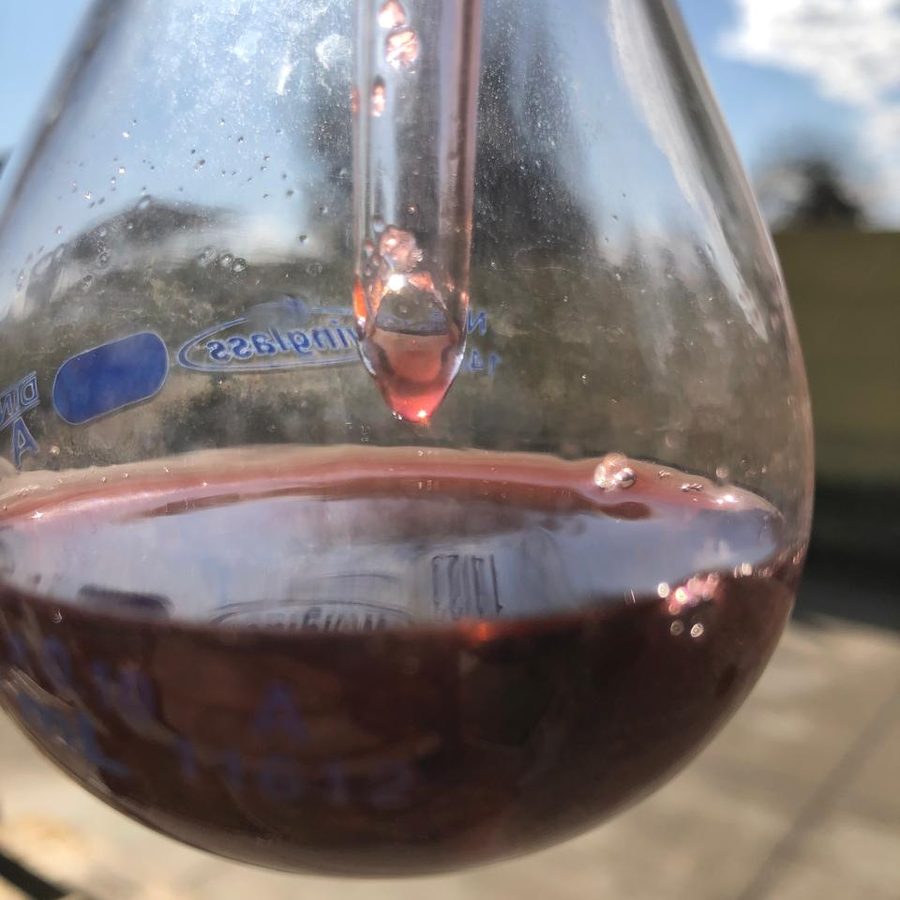
Cobalt sulfate produced at EcoMinería’s (Ecoprojects) Lampa plant. EcoMinería (Ecoprojects) and EcoBaterías archive.
Cobalt sulfate recovered from battery recycling was successfully tested at the hydrometallurgical plant of Codelco El Teniente: testing from November 2023, with results published in July 2024. Against imported sulfate, the press report recorded 22% lower cost, 40% lower consumption and a single daily addition instead of three. The article does not name the supplier.
Updated October 9, 2026 · Reviewed by the EcoBaterías technical team.
The hydrometallurgical plant of Codelco División El Teniente uses cobalt sulfate as an additive in the electrowinning of copper cathodes. For years that input arrived imported and in solid form, which dragged along three linked operational drawbacks: it had to be dissolved before use, it had to be dosed several times a day to hold the concentration, and the supply chain depended on a product that travels thousands of kilometers and can run short.
None of the three is spectacular on its own. Together, though, they describe rather well why an imported input can be expensive beyond its price: the real cost includes the preparation step, the labor of each addition and the risk of running out.
From November 2023 the plant tested cobalt sulfate recovered from lithium battery recycling, delivered in solution rather than as a solid. The change of format is not a detail: an additive that arrives already dissolved removes an entire preparation stage on site and allows standardized dosing.
The results were made public in July 2024 in a regional press report. The tense matters: this is a trial with published results, not a current supply contract and not a product certification.
| Dimension | Imported sulfate (reference) | Recycled cobalt sulfate |
|---|---|---|
| Additive cost | Reference | 22% lower |
| Additive consumption | Reference | 40% lower |
| Additions per day | 3 | 1 |
| Delivery format | Solid, dissolved on site before use | Solution ready to dose |
Swipe to see the full table
Source: El Rancagüino, «El Teniente prueba con éxito uso de sulfato de cobalto reciclado para la obtención de cátodos de cobre» (opens in a new tab) · July 15, 2024
El líquido anduvo mejor, el efecto es bastante más rápido y es más barato.
Precision is worth more than enthusiasm here, so it is worth being explicit.
There is also a caveat we prefer to state before anyone else finds it: the El Rancagüino article does not name the supplier, and we do not attribute it to anyone here either. The videos and archive photographs of the Lampa plant, operated by EcoMinería (Ecoprojects), a founding partner of EcoBaterías, are in the Lampa plant and the El Teniente trial.
The input does not appear out of nowhere: it is the last link in a chain that starts with an end-of-life battery. The pack is discharged, dismantled and ground; the resulting powder —black mass and the metals it concentrates— goes into a controlled leach; the solution is purified in stages and finally crystallized or adjusted to the concentration the customer asks for. EcoBaterías’ hydrometallurgical process comes from EcoMinería (Ecoprojects), a founding partner, which ran it at its Lampa plant (Santiago Metropolitan Region) under a 2020 health permit issued in its name by the Seremi de Salud RM (Chile’s regional health authority); the new plant is under review by the Seremi de Salud RM, and the detail is in compliance and permits.
Finishing the chain inside Chile has a consequence that is often overlooked: what leaves the plant is a mineral product, not waste, so it is not subject to the prior informed consent procedure of the Basel Convention. We explain it in the Basel Convention and lithium batteries.
For a company accumulating end-of-life batteries the case has a very concrete reading: it shows there is a route in which its waste can end up as an input for domestic mining rather than as a waste shipment to another continent. That route also produces the document regulation will ask for. The full framework is in the complete guide to Chile’s EPR law for batteries; if what you need is to verify the receiver’s credentials, the criteria are in how to recognize a licensed lithium battery waste manager, and the drop-off routes are in where to recycle lithium batteries in Chile. For a company with a batch, the lithium battery recycling service for companies coordinates pickup with licensed hazardous-waste carriers and manages valorization with authorized receiving facilities; the authorized receiving facility issues the valorization certificate per batch.
If the same inventory also holds decommissioned photovoltaic modules, their calendar is different and already fixed: it is explained in Supreme Decree (DS) 22/2025 and the solar panel targets.
Written by the EcoBaterías technical team. Whenever we cite this case we add the caveat published in datos/empresa.json: the press article does not name the supplier.
We quote the testing and tell you which route makes sense: repair, second life or recycling through authorized receiving facilities.
The videos and archive photographs of the Lampa plant, operated by EcoMinería (Ecoprojects), and the published evidence from El Teniente.
The intermediate that cobalt sulfate is obtained from, and why its composition changes with each chemistry.
Testing, repair, refurbishment, second life, recycling and pickup of batteries and panels, with a technical report for every batch.